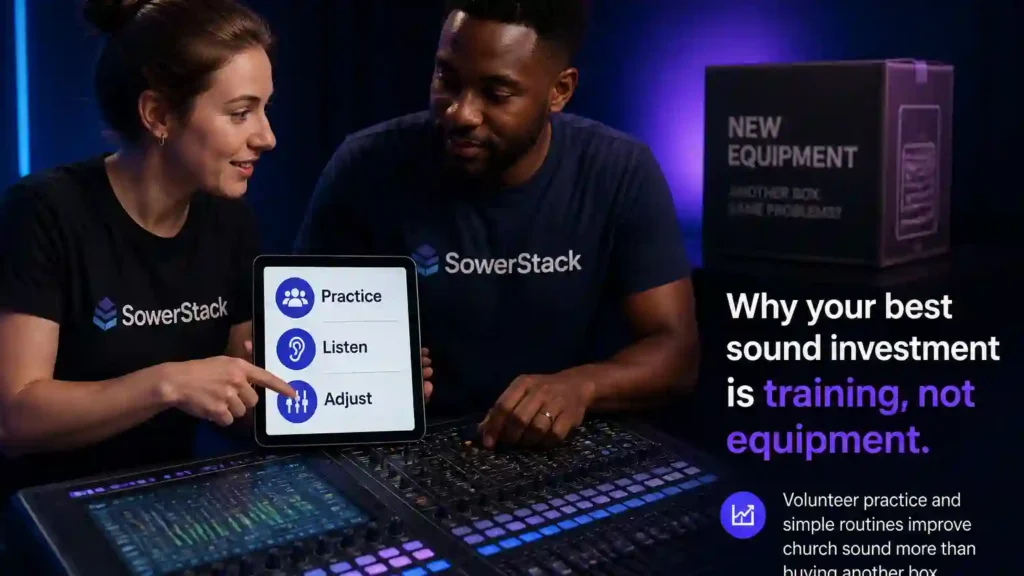
A sound volunteer can usually tell you where the weak spots are before anyone else notices them. They know which microphone is a little too quiet, which monitor starts to ring when the singer steps closer, and which fader they avoid touching because last time it created a problem they did not know how to fix. They are not careless. Most of them are trying hard with the knowledge they have.
That is why church audio often becomes a purchasing conversation when it should begin as a training conversation. A new mixer feels like progress because the church can order it and install it quickly. Training feels less visible, but it often changes the room more than another box on the equipment table.
If your church has ever wondered why better gear did not produce the improvement you expected, the answer may not be that you bought the wrong thing. The answer may be that the people serving behind the board need clearer instruction and the confidence that comes through guided practice.
The first investment is understanding
What training changes
Church sound is a ministry of clarity. The purpose is not to impress the room with technical excellence. The purpose is to help people hear the Word and participate without distraction as the church sings together. That goal depends on equipment, but it depends even more on understanding.
A modest system in trained hands can serve a church faithfully for years. A more expensive system in uncertain hands can still feel unpredictable every Sunday. The difference is usually not hidden inside the mixer. It is in the habits of the person operating it.
Training helps volunteers understand why a sound problem is happening instead of only reacting to the symptom. If the pastor sounds thin, a trained operator listens for microphone placement and gain structure before reaching for the main volume. If a monitor feeds back, they know the issue is not solved by panic or by turning everything down until the singer cannot hear. They learn to diagnose.
Diagnosis is what protects a church from repeated purchases. Without it, every audio problem feels like a gear problem. With it, you can decide whether the need is a better microphone, a different speaker position, a repaired cable, or a better setup process.
Why new equipment feels easier
New equipment gives leaders a concrete way to respond to an obvious frustration. People complain that the sound is muddy. The worship leader says the monitor is hard to hear. The livestream audio sounds uneven. A purchase seems like a faithful attempt to solve the problem.
That instinct is understandable. Pastors and ministry leaders carry enough invisible work. When a visible tool promises relief, it is natural to pay attention. A product page gives specifications and reviews next to a clear price. Training requires the right person, a workable schedule, and trust in a process that may feel less predictable.
Equipment also feels safer because it does not require anyone to admit what they do not know. A volunteer can receive a new mixer without feeling exposed. A training session asks them to practice in front of someone who knows more than they do. That can feel vulnerable, especially for faithful volunteers who have been carrying the work for years.
We should not dismiss that concern. A good training culture does not embarrass volunteers. It honors them. It says, “You have been serving with care, and we want to give you better tools for the responsibility you already carry.”
The gap between capability and use
Many churches own equipment that can do far more than the team currently uses. A digital mixer may have scene recall, compressors, noise gates, custom monitor mixes, and remote control from a tablet. On Sunday morning, it may function like a basic volume board because nobody has been taught how to use the rest of it safely.
That does not mean the purchase was foolish. It means the purchase is unfinished. A tool reaches its real value when the people serving with it understand enough to use it well.
The same pattern shows up with speakers and microphones. A speaker may be capable of clear coverage, but it is aimed at the back wall instead of the people. A microphone may be reliable, but it is held too far from the speaker’s mouth. A monitor may be useful, but it is pointed in a way that invites feedback. In each case, the answer may be training before replacement.
Good stewardship asks a better question than “What should we buy next?” It asks, “What are we not yet receiving from what we already have?” That question protects both money and morale.
A simple audio stewardship path
Listen first
Name the actual problem in the room.
Train next
Teach volunteers how the system works.
Buy with clarity
Purchase only what solves a known limitation.
What a useful training session covers
A useful training session starts in your actual room with your actual system. The trainer should not spend the whole morning giving a lecture that could have been a video. They should stand with your volunteers, trace the signal path, and connect each control to something your team can hear.
The first layer is signal flow. Volunteers need to know how sound moves from a microphone through the mixer and out to the speakers, with monitor sends treated as part of the same path. Once that path is clear, troubleshooting becomes less mysterious. A silent microphone is no longer a crisis. It is a series of places to check.
The next layer is gain structure. Many Sunday sound problems begin because the signal is too weak in one place and too loud in another. Volunteers compensate by turning up the wrong control. Noise increases, feedback becomes more likely, and the mix loses clarity. A trainer can show your team how to set healthy levels before service begins.
Equalization should be taught with restraint. Volunteers do not need to become audio engineers overnight. They need to hear what low-mid muddiness sounds like, what harshness sounds like, and how small adjustments can help speech and music become clearer. The best training gives them ears before it gives them tricks.
Monitor setup deserves direct attention. Many churches struggle less with the main speakers than with what happens on the platform. If singers cannot hear, they push harder. If instruments become too loud on stage, the room mix suffers. A trainer can help your team set monitor levels in a way that serves both the people leading and the people listening.
Why volunteers need confidence
Volunteers often serve under quiet pressure. They know everyone hears their mistakes. If the microphone squeals, the whole room turns around. If the sermon audio drops, the moment feels larger than the technical issue itself. That pressure can make even capable people hesitant.
Training gives volunteers permission to act wisely. A hesitant operator may leave a muddy vocal alone because they do not want to make it worse. A trained operator knows which adjustment to try and how far to move it. They are not guessing as much. They are listening with a framework.
Confidence also helps a team share responsibility. If only one person understands the system, that person becomes the emergency plan. They get texts on Saturdays, questions on Sundays, and pressure whenever something changes. Training spreads knowledge across the team so one volunteer does not carry the whole system alone.
This matters pastorally. Your sound volunteers are not machines who exist to keep the service running. They are people in your church who need encouragement, clarity, and a sustainable way to serve. Equipping them is part of caring for them.
How to find the right trainer
A good trainer for a church does not need to be famous. They need practical experience, patience, and the ability to explain live sound without making volunteers feel small. The best person may be a local sound engineer who mixes concerts and community events while understanding how churches work.
Start by asking nearby churches who they trust. Local venues may know engineers who teach well. A recording studio may be able to point you toward someone who understands both audio and people. You are looking for someone who can listen to your room, not someone who arrives with a fixed opinion about what every church should buy.
Ask a few simple questions before scheduling. Have they trained volunteers before? Are they comfortable working with your current equipment? Will they spend time on setup habits, troubleshooting, microphones, monitors, and gain structure? Can they provide a short written set of notes afterward so your team has something to review?
Pay them fairly. A four-hour Saturday session may cost a few hundred dollars, depending on your area and the trainer’s experience. That amount can feel significant, but it is often less than one mid-range microphone or a small accessory order. The difference is that training keeps serving long after the morning ends.
How to prepare your team
Preparation helps a training session become practical instead of generic. Ask each volunteer to write down two or three recurring problems they face. The best questions are specific: “Why does the lapel microphone sound thin?” or “Why does the monitor feed back when the keyboard is louder?” Specific questions give the trainer a map.
Set up the room as it normally functions on Sunday. Use the same microphones, speakers, stands, cables, and monitor positions. If your worship team can attend for part of the session, give the sound volunteers time to practice with live voices and instruments. Live sound is learned by listening to real sources in a real room.
Protect the tone of the day. The goal is not to expose every mistake. The goal is to build shared understanding. Begin by thanking the volunteers for what they already carry. Make it clear that questions are welcome and that nobody is expected to know everything.
Record the settings and practices that come out of the session. Take pictures of speaker angles and monitor positions, then note the mixer settings that matter. Create a simple Sunday checklist. The value of training grows when the team can repeat what they learned.
What to practice after training
Training becomes useful when it changes weekly habits. A Saturday session should lead to a calmer Sunday process, not only a folder of notes. Your team needs a few repeated practices that make the system easier to manage.
Begin with a pre-service line check. Every microphone and instrument should be checked before people arrive. The goal is not a full rehearsal. The goal is to confirm that each source reaches the mixer with a clean signal and goes where it belongs.
Use consistent starting points. If your mixer allows scenes or snapshots, save a basic Sunday setup after the trainer helps you build it. If your mixer is analog, mark common positions with tape or a printed photo. Consistency gives volunteers a safe place to begin.
Debrief gently after services. A five-minute conversation can help the team learn without making audio the center of the day. Ask what went well, what felt uncertain, and what should be adjusted next week. Small improvements compound when they are noticed.
When equipment is still the right answer
Training does not remove the need for wise purchases. Some systems really are missing what the room requires. A speaker may not cover the seating area. A wireless microphone may be unreliable. A mixer may not have enough inputs for the way your church now serves.
The difference is that trained volunteers can help you buy with more confidence. They can describe the limitation clearly. They can distinguish between a tool that would make ministry easier and a feature that sounds impressive but will sit unused. They can also tell you what should wait.
That kind of clarity protects your resources. It keeps the church from buying around confusion. It also helps leaders explain purchases to the congregation with integrity. “We need this because we have diagnosed this specific limitation” is a stronger sentence than “We hope this makes everything better.”
Buying after training does not make equipment less important. It puts equipment in its proper place. Tools serve people. People serve the ministry. The order matters.
A better question for church audio
The most useful audio question is not always, “What do we need to replace?” A better starting point is, “What do our people need to understand so they can serve faithfully with what we have?”
That question changes the tone of the conversation. It respects the volunteers who are already giving their time. It respects the resources your church has already invested. It also respects the people sitting in the room who need to hear clearly without being distracted by preventable problems.
We can help you think through the system before another purchase becomes the default answer. Sometimes the next faithful step is a new microphone or a different speaker. Very often, the next faithful step is a trained volunteer who finally understands what the room has been trying to tell them.
Clear sound is not about technical pride. It is about serving the message and the people who came to hear it. Training is one of the quiet ways a church can practice that kind of stewardship for years.

Recent Posts
-
 “Broadcast” was a farming word first, and it changes how you read Matthew 13
 -
 What broadcasting actually looks like in an ordinary week
 -
 The one ChMS report that tells you if people are actually connecting
 -
 Breeze vs ChurchTrac: Which One Fits a Smaller Church Better?
 -
 How to evaluate church management software for your size church