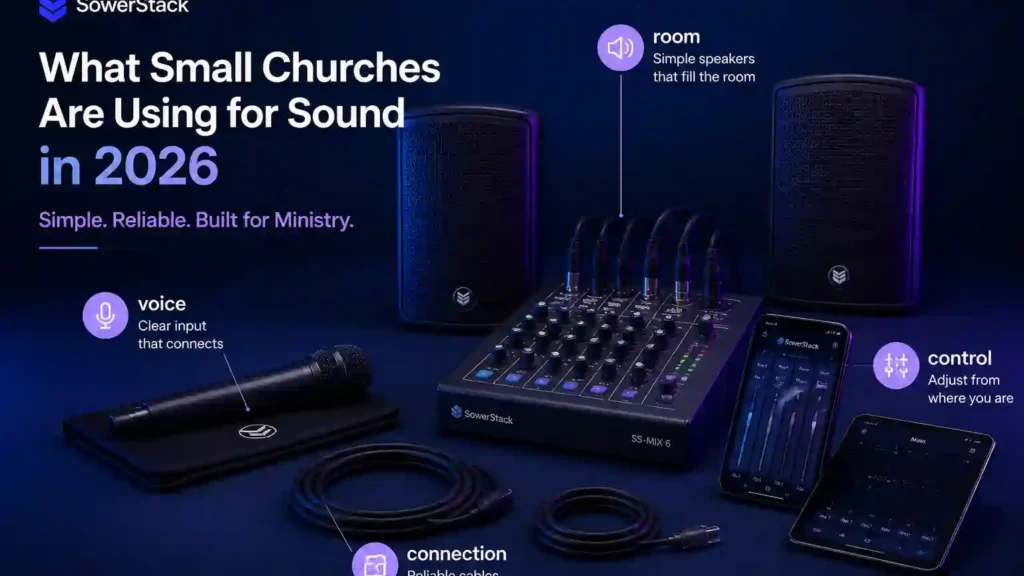
Some small churches do not need a complex sound system. A powered speaker, a wired microphone, a stand, and the right cables may be enough for a simple room where the main goal is clear speech and congregational singing.
That last part matters. Good sound in a small church is not measured by how impressive the gear looks. It is measured by whether people can sing, listen, pray, and hear the Word without distraction. The system has done its job when it disappears into the service.
Most smaller churches do not need an audio system built around professional assumptions. You need a system that fits the room, the people who will run it, and the ministry you are actually leading. The best choices are usually simpler than the internet makes them appear.
What small churches are actually solving
A small church sound system is a path
| Part | Job | Common mistake |
|---|---|---|
| Microphone | Captures the voice clearly | Standing too far away |
| Mixer | Balances the sources | Changing too many knobs at once |
| Speakers | Covers the room | Pointing sound back into microphones |
| Cables | Connects the system safely | Buying the cheapest path in the system |
Small church sound is usually about clarity before it is about quality. A person in the back row needs to hear the sermon without straining. A worship leader needs enough volume for the room to sing together. A visitor needs to feel like the gathering has been prepared with care, not like the whole room is held together by nervous improvisation.
That does not require the same system a touring band would use. It does not even require the same system a much larger church across town may have installed. A church of fifty people in a fellowship hall has a different problem from a church of five hundred people in a fan-shaped auditorium. Buying as if those two rooms are the same usually creates more complexity than usefulness.
The first question is not, “What is the best sound system?” The first question is, “What job does our sound system need to do every week?” If your primary need is one speaking voice in a small room, a simple powered speaker may be enough. If you have several singers along with acoustic guitar, keyboard, and a pastor who moves around while preaching, you need a little more structure. If you meet in a rented room and carry everything in each week, portability may matter more than every technical preference.
This is stewardship language, not gear language. Churches spend wisely when they name the real ministry task before they name the equipment. That protects you from both extremes: buying too little and fighting the same avoidable problem every Sunday, or buying more than your room and volunteers can reasonably manage.
A simple sound fit map
The simple setup that keeps serving well
A basic powered speaker and wired microphone can serve a small congregation faithfully when the room is modest and the main need is speech reinforcement. A powered speaker has the amplifier built into the cabinet, which removes a whole layer of equipment from the system. You plug the microphone into the speaker, set the volume, and leave it alone.
This setup often includes a powered speaker such as a Yamaha DBR10. A QSC CP8 or JBL EON710 can also fit the same role. These models are not exotic. They are common because they are sturdy, clear enough for speech, and easy for a volunteer to understand. Paired with a Shure SM58 or another dependable dynamic microphone, the whole system can often be built for a few hundred dollars if you shop carefully.
The strength of this setup is not that it can do everything. It works because it does one thing simply. It makes a speaking voice audible in a small room. It avoids extra monitor speakers and complex routing, along with a booth full of controls no one wants to touch.
A simple system also lowers the pressure on volunteers. A person who would never agree to run a full sound board may be willing to set up one speaker and one microphone. That matters for a small church. The system you can actually staff is usually better than the system that looks better on paper but sits unused or half-understood.
This kind of setup is especially useful for church plants and midweek studies. It can also serve nursing home services or congregations that need to set up quickly in small sanctuaries. It fits in a car. It can be explained in one short conversation. It does not require a person with audio experience to keep Sunday morning moving.
When music changes the needs of the room
Music introduces more sources, and more sources require more decisions. A pastor speaking into one microphone is one signal. A worship leader with singers, acoustic guitar, keyboard, and a preaching microphone becomes a small system. That is the point where a mixer starts to make sense.
A small analog mixer such as a Yamaha MG series board or a Behringer Xenyx model can be a good fit when you need several channels but do not need a complicated digital console. A mixer lets you set levels for each microphone or instrument, balance the room, and keep the service from depending on one volume knob on a speaker.
At this level, many churches add a second speaker so the room hears more evenly. Some use powered speakers because they are simple to connect. Others use passive speakers with a separate amplifier because the equipment is already in place or because a knowledgeable volunteer is comfortable maintaining it. Either approach can work when it fits your room and your people.
Wireless microphones often enter the conversation here. A handheld wireless microphone or a lavalier system gives a pastor more freedom to move, especially in rooms where a cable would be distracting. The benefit is real, but it comes with more responsibility. Batteries need to be checked. Frequencies need to be set correctly. The receiver has to be connected and tested before the service starts.
The wise move is to add one layer at a time. If you add a mixer, learn the mixer before adding wireless. If you add wireless, build a battery habit before adding more microphones. Every new piece of gear should come with a matching practice. Equipment without a habit eventually becomes confusion.
Portable systems for churches that set up every week
Portable churches need sound systems that respect the strain of weekly setup. A system may sound good in a showroom and still be a poor fit if it takes too long to assemble, requires careful packing, or depends on one tired person remembering every connection before the service starts.
Battery-powered speakers and compact column systems have improved enough that many small gatherings can use them with confidence. Models such as the Bose S1 Pro+ and JBL EON One Compact show up often because they are light, self-contained, and easy to carry. They are not meant to replace a full system for a large room. They are meant to help a small gathering worship and listen without hauling half a trailer of gear.
For a church plant meeting in a living room or storefront rented for worship, this kind of system may be exactly enough. The same can be true in a coffee shop or school classroom. One speaker can handle a microphone and music playback. A second speaker can be added if the room shape requires it. The important question is whether the people in the room can hear clearly and whether the setup can be repeated without anxiety.
Portable systems need labels more than they need sophistication. Label the power cable. Label the microphone cable. Put the adapters in one pouch. Keep batteries in the same bag every week. Write the setup order on a card and tape it inside the lid of the case. These small habits protect the service from unnecessary friction.
A portable church does not need to feel temporary in its preparation. People can sense when a room has been readied with care. They do not need professional production. They need a gathering where the practical details support the spiritual work instead of constantly interrupting it.
House churches and very small gatherings
A gathering of fifteen to twenty-five people in a living room may not need voice amplification at all. In that setting, the intimacy of the room is part of the ministry. A microphone can make a normal conversation feel oddly formal. The better choice may be a clear speaker for music and no microphone for the teaching.
Consumer Bluetooth speakers can serve this setting well when expectations are honest. A JBL Charge or Bose SoundLink can support worship songs in a small room. It will not create the same experience as a sanctuary system, and it does not need to. It only needs to help the group sing together without a phone speaker straining on a coffee table.
The caution is reliability. Bluetooth can disconnect. Phones receive notifications. Batteries run down. If you use a consumer speaker, build a simple habit around it. Charge it the night before. Put the phone on do-not-disturb. Keep a cable available if the speaker allows wired input. Small gatherings benefit from simple preparation just as much as larger ones do.
Some very small churches eventually add a small USB audio interface or compact powered speaker when music quality becomes more important. That can be a wise step if it solves a real problem. It is not a required sign of maturity. The right system is the one that helps the gathering participate without drawing attention to itself.
Inherited systems deserve careful assessment
Many small churches already have sound equipment installed by someone who is no longer present. There may be speakers on the wall, cables through the ceiling, a mixer in the back, and a collection of mystery adapters in a drawer. The system may still be capable of serving well, even if nobody currently understands it fully.
This situation calls for patient assessment rather than immediate replacement. Ask what works consistently. Ask what fails occasionally. Ask which channels are actually used, which microphones are dependable, and which cables cause problems. You may discover that the system needs labeling, a new cable, or a short training session more than it needs a major purchase.
A local audio technician can often add years of usefulness to an existing system in one visit. For a reasonable fee, they can trace the signal path, label the inputs, remove unused clutter, identify one or two weak points, and write down a basic operating procedure. That kind of visit may not feel exciting, but it is often one of the best sound investments a small church can make.
Inherited equipment also carries emotional history. Someone gave money for it. Someone installed it. Someone may have spent years keeping it running. Treat that history with respect. The goal is not to declare the old system inadequate. The goal is to understand whether it still fits the ministry task and what would help it serve more clearly.
The volunteer matters more than the gear list
A dependable volunteer who understands signal flow is worth more than a more expensive system nobody can operate. Sound equipment does not run itself. Someone has to know which microphone is live, where the feedback is coming from, how to mute a channel, and when to leave the controls alone.
That means training belongs in the sound budget. If you have a few hundred dollars to improve sound, consider whether part of that money should go toward a local technician walking your volunteers through the system. A church can buy a better microphone and still struggle if no one knows how to set the gain. A volunteer with confidence can often get better results from ordinary gear than an anxious volunteer can get from expensive gear.
Training should be practical and repeatable. Teach the difference between input gain and volume. Show how to prevent feedback by keeping microphones behind the speakers when possible. Explain why cables fail and how to test them. Create a one-page reference sheet that lists the Sunday setup order and the most common fixes.
The point is not to turn volunteers into engineers. The point is to give faithful servants enough understanding to serve without fear. A calm person at the sound position changes the feel of a service. They do not draw attention to themselves, and that is part of the gift.
How to choose by fit instead of pressure
A church should choose sound equipment by matching the room, the ministry need, and the available operators. If those three factors are clear, the buying decision becomes much simpler. You stop comparing yourself to churches with different circumstances and start asking what faithfulness looks like in your setting.
Walk through the room when it is empty. Stand where people sit. Notice where the preacher’s voice carries and where it fades. Think about the kind of music you actually use, not the kind of music another church uses. Count the number of microphones and instruments you need on an ordinary Sunday. Then ask who will set it up, who will run it, and who will troubleshoot it when something is not behaving.
This process may point you toward a basic powered speaker and microphone. It may point you toward two speakers with a small mixer and a few reliable microphones. It may tell you to keep the inherited system and spend money on labels, cables, and training. Each of those can be a wise answer.
We care about these choices because digital and technical tools should serve ministry rather than distract from it. Sound is not the whole work of the church, but it shapes whether people can hear the sermon, sing with the congregation, and participate without avoidable barriers. That makes it a stewardship issue.
A faithful sound system is usually quieter than you think
The best small church sound system is often the one people stop noticing. The sermon is audible. The music supports the room. The volunteer knows what to do. The setup can be repeated next Sunday without a long explanation.
That kind of system may cost less than you expected. It may already exist in your building and simply need attention. It may require one new speaker, one better microphone, or one afternoon with someone who can label the confusing parts. The right answer is not always more equipment.
Small churches have always learned to steward what is in their hands. Sound equipment is another place to practice that wisdom. Buy what fits. Train the people who serve. Keep the system simple enough to sustain. Then let the technology fade into the background so the ministry can stay in the foreground.
If you are trying to make practical technology decisions with limited resources, we can help you think through the pathway before you spend money on tools. The goal is not a more impressive setup. The goal is clear ministry with whatever God has given you to work with.

Recent Posts
-
 “Broadcast” was a farming word first, and it changes how you read Matthew 13
 -
 What broadcasting actually looks like in an ordinary week
 -
 The one ChMS report that tells you if people are actually connecting
 -
 Breeze vs ChurchTrac: Which One Fits a Smaller Church Better?
 -
 How to evaluate church management software for your size church