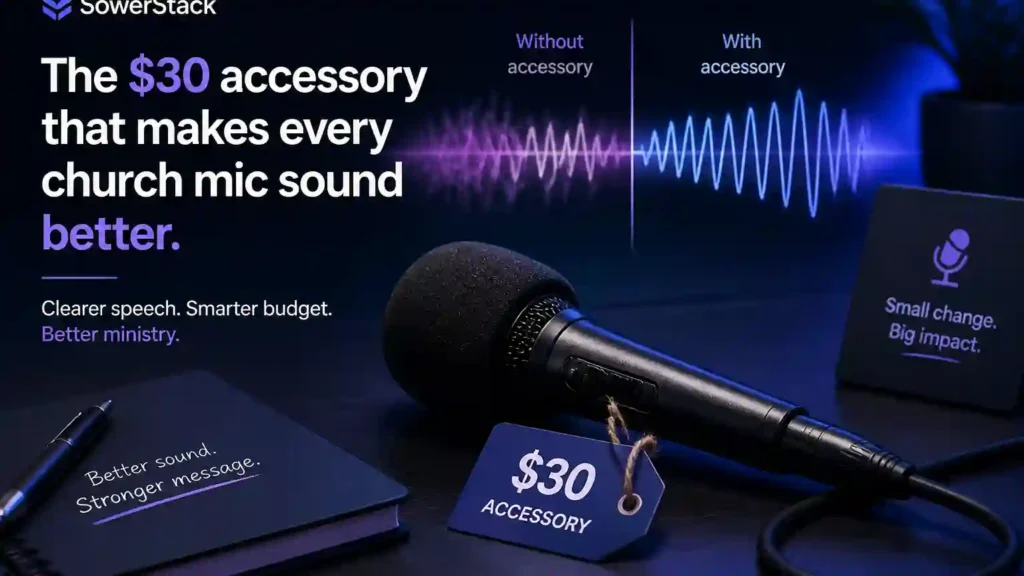
A sound volunteer can spend an entire Sunday morning chasing a problem that costs less than lunch to fix. The pastor says “prayer,” and a low thump comes through the speakers. He says “but God,” and the room feels a small puff of bass that has nothing to do with the sermon. The volunteer reaches for the mixer, trims the low end, adjusts the gain, and asks the pastor to hold the microphone differently.
Some of those adjustments help a little. None of them solve the source of the problem. The microphone is not broken. The speaker system may be doing exactly what it was designed to do. The issue is often the burst of air from the speaker’s mouth hitting the microphone capsule before it can become clear speech.
A simple foam windscreen fixes that problem in many church rooms. For a standard handheld microphone, a good windscreen usually costs between $7 and $12. If you add a spare windscreen, a reliable microphone clip, or a short replacement cable, the whole improvement still often stays near $30. It is not an impressive purchase, which is part of why it is so easy to overlook.
Clear audio is not a luxury in church. People can only respond to the Word they can hear without distraction. A small piece of foam can remove one of the most common distractions in spoken audio.
The small accessory that solves a real problem
When a small accessory helps
| Symptom | Possible accessory | Why it helps |
|---|---|---|
| Popping on p sounds | Foam windscreen | Softens bursts of air close to the grille |
| Handling noise | Stable stand or clip | Keeps the microphone still |
| Messy setup | Right-length cable | Reduces clutter and trip risk |
A foam windscreen is a shaped piece of open-cell foam that slides over the grille of a microphone. It needs no battery or menu, and there are no settings to learn. It simply sits between the speaker’s mouth and the microphone capsule.
That small barrier matters because certain consonants push air forward with force. Words that begin with P, B, T, and D can send a short burst of air into the microphone. When that air hits the diaphragm, the sound system reproduces a low-frequency pop. Audio people call these plosives, but you do not need the technical term to recognize the problem. You hear it as thumps, bumps, and sudden bursts of low sound.
A windscreen slows and diffuses that air before it reaches the microphone. The voice still reaches the capsule, but the burst of air loses its force. The result is not dramatic in the way a new speaker system is dramatic. It is better because a distraction disappears.
This is why the windscreen is such a useful first audio improvement for churches. It addresses the problem at the source. You are not asking a volunteer to repair the signal after the pop has already entered the system. You are preventing the pop from becoming part of the signal in the first place.
Why plosives make preaching harder to hear
Plosive pops compete with the natural body of the human voice. They live in the low frequencies where warmth, fullness, and vocal weight also live. If a volunteer tries to remove them with equalization, the voice can become thin before the thumps disappear.
That is why the problem feels stubborn from the sound booth. Lowering the bass may reduce some rumble, but it can also make the pastor sound less natural. Reducing the gain may prevent the loudest pops from hitting as hard, but it can make quiet speech harder to hear. Asking the speaker to hold the microphone farther away may reduce the air blast, but it also weakens the voice and makes the room more dependent on the sound system.
The windscreen gives the volunteer a better starting point. When the microphone receives a cleaner signal, the rest of the system has less damage to manage. The mixer, speakers, livestream feed, and recording all benefit because the improvement happens before the sound is amplified.
This matters for listeners more than they may realize. Many people will not know why the sermon feels tiring to hear. They will not say, “The microphone had plosive problems.” They will simply experience the sound as unstable or harsh. Removing those small disruptions helps the message sit more naturally in the room.
How a windscreen protects speech
A spoken P or B pushes air toward the mic.
The windscreen spreads that air before impact.
The capsule receives more voice and less thump.
The message reaches listeners with fewer distractions.
Why churches often overlook windscreens
Many churches buy microphones without realizing the windscreen is a separate accessory. A handheld microphone can work without one, so the missing accessory does not announce itself. The problem appears later as a sound quality issue, and people naturally look to the mixer or speakers for the fix.
The low cost also works against the windscreen. When an audio problem has bothered a church for months, a $10 answer feels too small. You may assume the solution should match the level of frustration. In audio, that assumption often leads churches to consider larger purchases before checking the simple parts of the signal chain.
There can also be a visual concern. A foam windscreen changes the look of the microphone. Some people think it looks less polished. That concern is understandable, especially in churches that care about a clean platform. Still, wind protection is a normal part of professional audio. Broadcasters, field recordists, and live audio technicians use some form of wind protection because the physics of air movement do not change when the setting becomes more formal.
The final reason is habit. If the microphone has always been used without a windscreen, no one may think to ask whether a small accessory would help. Ministry teams get used to tolerating certain problems because Sunday keeps coming. A windscreen is the kind of correction that becomes obvious only after you hear the difference.
Which windscreen to buy
The simplest recommendation for many churches is the Shure A58WS. It is made for the Shure SM58 and fits many standard handheld dynamic microphones with a rounded grille. It is widely available from music retailers and often costs between $7 and $12.
If your church uses an SM58 or Beta 58A, this style of windscreen is a natural first choice. The same is often true for another handheld vocal microphone with a similar ball grille. Buy black unless you have a reason to choose another color. Black tends to disappear visually, which helps people focus on the speaker rather than the accessory.
It is wise to buy at least two. Keep one on the main speaking microphone and one as a spare. Foam wears down over time as it absorbs breath moisture and dust. Eventually it loses its shape. Replacing a windscreen every six to twelve months is normal, especially for microphones used every week.
If your microphone has a different shape, measure the grille or check the manufacturer’s accessory list. Generic cylindrical windscreens can work well for many podium, instrument, and handheld microphones. They may not fit as neatly as a model-specific windscreen, but a secure fit is more important than having the exact brand on the package.
Avoid using a studio-style metal pop filter on a handheld church microphone. Those screens are designed for fixed recording setups where the speaker stays in one place. They are not a good fit for a microphone that gets passed from person to person, moved around a pulpit, or held during prayer and announcements.
How to install it well
Installation is simple. Slide the foam over the microphone grille until it seats firmly against the body of the microphone. The windscreen should feel snug enough that it will not slip during a service.
If the windscreen is loose, try a better-fitting size rather than forcing it to work. A loose windscreen can creep upward or fall off, which creates a distraction at exactly the wrong moment. If you must use a generic windscreen temporarily, a small piece of gaffer tape near the base can help, but a proper fit is better for weekly use.
After installation, have the main speaker test a phrase with several plosive sounds. A simple phrase like “Peter and Paul prayed with boldness” will reveal whether the thumps are reduced. Listen in the room, not only through headphones, because low-frequency pops can behave differently once they reach the speakers.
You may not need to change any mixer settings. If the voice sounds slightly dull, make a very small adjustment to the high-frequency equalizer. Do not overcorrect. The point is not to make the microphone brighter than before. The point is to keep the voice natural while removing the air blasts that were never part of the voice.
How to care for a foam windscreen
A windscreen lives close to the speaker’s mouth, so basic care matters. Remove it occasionally, rinse it with warm water, squeeze out excess water gently, and let it dry completely before placing it back on the microphone. A monthly cleaning rhythm works for many churches, though heavily used microphones may need more frequent attention.
Never store a wet windscreen in a closed case. Foam needs to dry fully. If moisture stays trapped, the windscreen can smell unpleasant and break down faster. A spare windscreen helps because you can rotate them while one dries.
Replace the windscreen when it becomes misshapen, brittle, torn, or permanently discolored. This is not a failure of the product. Foam is a wear item. Treat it the way you treat guitar strings, batteries, or other small supplies that support weekly ministry.
If several people share the same microphone during a service, consider keeping extra windscreens available. Some churches prefer to change windscreens between uses during seasons when illness is common. Others simply clean them on a regular schedule. Choose a practice that fits your church’s context and keeps the microphone pleasant to use.
The windscreen helps beyond regular preaching
Outdoor services reveal the value of a windscreen quickly. A breeze moving across an unprotected microphone can create a roaring sound that overwhelms speech. A foam windscreen will not eliminate strong wind, but it can reduce enough noise to make prayer and Scripture reading easier to understand. Announcements benefit from the same protection.
That matters for outdoor ministry gatherings where the room is not controlled. Baptisms, graveside services, and worship nights often have fewer audio controls than a sanctuary. Preventing wind noise at the microphone becomes more important because there may be less equipment available to shape the sound later.
A windscreen also helps speakers maintain a healthier distance from the microphone grille. Some people naturally press the microphone too close to their mouth. The foam creates a small physical buffer that discourages direct contact with the metal grille. That can reduce muddiness and protect the microphone from moisture.
These benefits are modest by themselves, but they add up. Better speech clarity is usually not one giant improvement. It is the result of several small corrections that remove distractions between the speaker and the listener.
Why a microphone clip may be part of the same fix
A windscreen protects the sound at the capsule, but the microphone still needs to be held or mounted securely. A worn-out microphone clip can let the mic sag, rotate, or rattle during preaching. When that happens, the speaker may compensate by holding the mic awkwardly or moving in and out of the pickup area.
A replacement clip is inexpensive and often worth buying with the windscreen. Choose a clip that fits the microphone body firmly and attaches securely to your stand. If the main preaching microphone lives on a pulpit or stand, a good clip keeps placement consistent from week to week.
Consistency helps volunteers. When the microphone begins in the same position each week, the gain setting, equalization, and overall level are easier to manage. When the microphone position changes constantly, the volunteer has to solve a new version of the room every Sunday.
The clip is not as important as the windscreen for plosive control, but it belongs in the same category of small parts that keep the larger system working well. A church can own good microphones and still fight avoidable problems if the accessories are worn, loose, or missing.
Why a short XLR cable can be worth replacing
A crackling or intermittent cable can make a good microphone sound unreliable. If the main speaking microphone uses a short XLR cable at a pulpit, lectern, or stage box, check whether that cable is still in good condition. Wiggle the connectors gently during a sound check. Listen for pops, crackles, dropouts, or hum.
If the cable is noisy, replace it with a reliable short XLR cable from a reputable audio brand. This is not about buying the most expensive cable on the wall. It is about avoiding the frustration of a weak connection in the most visible audio path in the service.
Together, the windscreen, clip, and short cable form a practical microphone refresh. The total cost may land near $30 to $40 depending on the parts you choose, and each item addresses a common source of distraction. You are improving the first link in the chain.
That is good stewardship. Before assuming your church needs a larger audio upgrade, make sure the basic signal path is healthy. A clean source gives every other piece of equipment a better chance to serve the room.
A simple test before you buy anything larger
Use the microphone your pastor or main teacher uses most often. Set it at the normal speaking distance and say a phrase with repeated P and B sounds. Listen through the room speakers at a realistic service volume. If you hear low thumps that jump out from the voice, the microphone needs wind protection.
Then test for handling and cable noise. Hold the microphone as it would be held during a service. Move it gently. Place it in the clip. Touch the cable near the connector. You are not trying to create problems. You are checking whether normal use creates noises that the room will hear.
Finally, test the same microphone after installing the windscreen. Use the same phrase at the same distance and volume. The comparison should be clear. The voice should remain natural, while the low-frequency pops should be reduced or gone.
This kind of test gives you confidence before spending money on larger equipment. It also helps volunteers hear the difference for themselves. When people understand what the accessory is doing, they are more likely to keep it in place and maintain it well.
Small improvements are part of faithful stewardship
Church audio is a ministry of clarity. It serves preaching, prayer, Scripture reading, testimony, and invitation. When the sound is clear, people can give their attention to the message instead of the equipment.
That does not mean every church needs expensive gear. Many churches are doing faithful ministry with modest systems and volunteer operators while working with limited resources. The question is not whether your equipment looks impressive. The question is whether the tools you have are serving the people in the room as well as they reasonably can.
Small improvements deserve attention because they respect both the message and the listener. A foam windscreen is not glamorous. No one will walk into church and congratulate the sound volunteer for buying one. They may simply stop noticing a problem, which is often what good audio work feels like.
This principle reaches beyond microphones. Ministry systems often improve when you identify the actual constraint instead of assuming the answer must be large. Sometimes the next faithful step is a new system, a new process, or a significant investment. Sometimes it is a small correction that removes friction from work you are already doing.
What to do this week
Start with the microphone used for preaching or teaching. If it does not have a foam windscreen, order one that fits. If you use a standard handheld dynamic microphone, the Shure A58WS is a strong place to begin. If your microphone has a different shape, measure it and choose a secure-fitting foam cover.
Buy a spare if you can. Check the microphone clip and the short cable at the same time. Replace any part that is loose, noisy, cracked, or unreliable. Keep the spare windscreen somewhere the sound volunteer can find it without searching through a closet five minutes before service.
Install the windscreen before rehearsal or sound check, not during the service. Let the main speaker test it. Listen for the difference. Make only small mixer adjustments if the voice needs them.
Your church does not need to spend heavily before solving simple problems. The people listening need the message to be clear. A small piece of foam can help make that happen, and that is worth taking seriously.

Recent Posts
-
 “Broadcast” was a farming word first, and it changes how you read Matthew 13
 -
 What broadcasting actually looks like in an ordinary week
 -
 The one ChMS report that tells you if people are actually connecting
 -
 Breeze vs ChurchTrac: Which One Fits a Smaller Church Better?
 -
 How to evaluate church management software for your size church