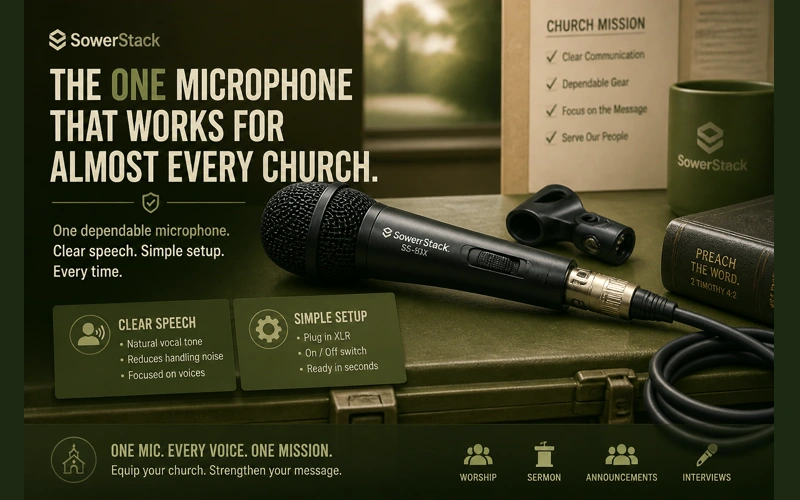
A small church buying its first microphone can get buried under conflicting advice. Some people recommend condensers because they sound detailed. Others recommend wireless systems because cables look less polished. A few suggest waiting until the church can afford something better.
For most churches, the better answer is simpler: buy a Shure SM58. It costs about a hundred dollars, works with a basic mixer, survives rough handling, and remains useful even after the church upgrades other parts of the sound system.
Why the SM58 keeps serving churches well
Microphone fit at a glance
Favors the voice close to the microphone, which helps preaching and announcements stay understandable.
Survives ordinary church handling, shared use, storage bins, and setup days.
Uses a standard XLR cable, basic stand, and ordinary mixer channel.
The Shure SM58 is a dynamic vocal microphone that has been in continuous use for decades because it solves ordinary live sound problems without asking much from the user. It is not the most delicate microphone. It is not the newest design. It is not trying to impress anyone with a feature list.
It does the work most churches actually need. It makes the human voice clear enough to understand. It rejects enough room sound to reduce feedback risk. It survives normal church handling. Those three qualities matter more on Sunday morning than a perfect studio frequency chart.
Many churches meet in rooms that were not built for amplified speech. Fellowship halls, storefronts, gyms, older sanctuaries, and multipurpose rooms all create their own challenges. A microphone that behaves well in imperfect rooms gives your volunteers a better starting point.
The SM58 also fits the way church equipment is used. A microphone may serve the sermon in the morning, announcements after lunch, a youth gathering on Friday, and an outdoor baptism service in the summer. Gear that can move between those settings without becoming fragile is valuable.
Start with speech clarity
Speech clarity is the first test of a church microphone because preaching, Scripture reading, prayer, and announcements all depend on intelligible words. People do not need a voice to sound expensive. They need to understand what is being said without strain.
The SM58 has a natural presence lift in the frequency range where consonants and vocal definition live. In plain language, it helps spoken words come forward. That is especially useful when the room is noisy, reflective, or filled with people who absorb sound unevenly.
A more sensitive microphone may capture more detail, but detail is not always your friend in live church sound. Sensitive microphones also capture more room noise. Reflections and HVAC rumble can enter the system along with sound from the speakers. In a studio, that sensitivity can be shaped carefully. In a small church room on Sunday, it can become one more thing to manage.
The SM58 gives you a practical kind of clarity. It favors the person speaking into it and ignores more of what is happening around it. That makes the pastor’s voice easier to place in the room and easier for a volunteer to manage.
Why a dynamic microphone fits small churches
Feedback resistance matters in ordinary rooms
Feedback happens when sound from the speaker reenters the microphone, gets amplified again, and forms a loop. The result is the sharp squeal that makes everyone tense. It can happen with any microphone, but some microphones make the problem easier to avoid.
The SM58 uses a cardioid pickup pattern, which means it is most sensitive to sound from the front and less sensitive to sound from the rear. That is helpful when the speakers are in front of the room and the microphone is pointed toward the person speaking. The microphone is designed to prefer the voice and reject some of the speaker sound.
Its dynamic element also helps because it is not as sensitive as many condenser microphones. That can sound like a weakness until you place the microphone in a live room. Less sensitivity means less unwanted room sound entering the system. Less unwanted room sound often means fewer feedback fights.
Speaker placement still matters. You should keep microphones behind the front line of the speakers when possible and avoid pointing the back of the microphone directly at floor monitors. The SM58 gives you forgiveness. It does not remove the need for basic setup wisdom.
Durability is a stewardship issue
A church microphone needs to survive more than careful use by trained people. It needs to survive the life of a congregation. Someone will set it down too hard. Someone will wrap the cable poorly. Someone will pack it in a tote with adapters and extension cords, plus a music stand part that does not belong there.
The SM58 is known for its steel grille and rugged body because those features keep it working under ordinary abuse. The internet is full of extreme stories about these microphones surviving punishment no church should test. Those stories are entertaining, but the more important point is simpler. The microphone is built for live use.
Durability protects the budget because replacement costs are ministry costs. A cheap microphone that fails twice is no longer cheap. A reliable microphone that works for years becomes less expensive every Sunday it serves.
Durability also protects attention. A pastor should not have to wonder whether the primary microphone will work this week. A volunteer should not have to apologize repeatedly for fragile gear. Dependable tools reduce the number of small anxieties that gather around Sunday morning.
What the SM58 actually costs
A new Shure SM58 usually costs between $99 and $109 from reputable retailers. The version with an on and off switch, called the SM58S, is often near the same price. Either version can serve a church well, so the better choice depends on how your people use microphones.
The standard model without a switch removes one possible mistake. Nobody can accidentally mute the microphone from the handle. That can be useful when several people share the microphone and may not notice the switch position. The sound volunteer controls muting from the mixer.
The switched model can be useful when a pastor or leader needs local control. It may help during rehearsals and smaller gatherings, especially in simple portable setups. The caution is that a switch can be bumped. If the person speaking is not used to checking it, the room may hear silence at the wrong moment.
The microphone itself is not the full cost. You need an XLR cable and usually a stand. A reliable 20-foot or 25-foot cable may cost $10 to $25. A basic boom stand may cost $25 to $40. A foam windscreen is optional, but it can help if a speaker has strong plosive sounds or speaks very close to the grille.
A complete wired vocal setup often lands around $140 to $170. That is a modest investment for a tool that may serve preaching, prayer, announcements, testimony, and music for many years.
Buy from a trustworthy source
Counterfeit SM58 microphones exist because the real microphone is so widely trusted. Some counterfeits look convincing from a distance, but they use weaker parts and sound noticeably worse. A price far below normal should make you cautious.
Sweetwater is a reliable source for church audio purchases. They usually carry the SM58 at standard pricing, and their sales engineers can help you confirm what cable, stand, or adapter you need. A helpful retailer can save you from buying pieces that do not connect to each other.
Amazon can also be fine when you buy directly from Amazon or from Shure’s official storefront. Be careful with unknown third-party sellers, especially if the price seems unusually low. Saving twenty dollars is not helpful if the microphone is not genuine.
Local music stores are worth considering too. You may pay the same price, and you may gain a relationship with someone nearby who can answer practical questions. For a church without an audio volunteer, a local source of help can be more valuable than a small discount.
Use the microphone close enough
Microphone distance determines more than many people expect. The SM58 is designed to be used close to the mouth, often within two to six inches. When someone stands a foot away, the microphone receives less voice and more room. The mixer then has to add gain, which raises noise and increases feedback risk.
Pastors often stand too far from the microphone because close placement feels unnatural. That is understandable. Many people think a microphone works like a camera and should simply capture whatever happens nearby. Live vocal microphones are different. They reward consistent closeness.
If the microphone is on a stand at a pulpit, place it so the grille points toward the speaker’s mouth. A boom arm or gooseneck can help. If the pastor turns their head often, angle the microphone to cover the normal range of movement, but do not place it so far away that it mostly hears the room.
If the microphone is handheld, teach people to hold it steadily near the mouth rather than waving it around. A handheld microphone does not have to feel awkward when the person using it understands the purpose. The closer voice gives the whole room more clarity.
Set the mixer for a natural voice
A few basic mixer settings can help the SM58 sound clear without turning soundcheck into a technical lesson. Start with the gain. Have the speaker talk at the volume they will use during the service. Raise the gain until the mixer shows a healthy signal without clipping or lighting red.
Then set the channel level and main volume so the back of the room can hear comfortably. The front rows may feel louder because they are close to the speakers and the person speaking. Do not set the whole room based on the front row. Walk to the back before deciding.
If your mixer has basic EQ, begin with small adjustments. A slight reduction in the low frequencies can reduce boominess caused by close microphone use. Leaving the middle mostly flat is often wise because the SM58 already brings the voice forward. A gentle high-frequency lift can add articulation, but too much can make speech sound brittle.
Make one change at a time. Volunteers lose confidence when every knob moves at once. A simple process lets them hear what each change does and return to a known starting point when something feels off.
Choose wired unless wireless solves a real problem
A wired SM58 is often the best first microphone because it is reliable, affordable, and easy to troubleshoot. If there is no sound, you can start with the cable and channel before checking mute and gain. The signal path is visible.
Wireless microphones solve a real problem when the speaker must move freely, when a cable creates a safety issue, or when the service format requires a hands-free setup. Those are valid needs. They simply belong to a different budget conversation.
A reliable wireless system using an SM58 capsule may cost several hundred dollars. That cost can be wise when mobility serves the ministry. A very cheap wireless system often brings interference, short battery life, and inconsistent sound. That can create more distraction than the cable would have created.
If you use a wired microphone, manage the cable well. Run it where people will not trip. Use gaffer tape when needed. Coil it properly after the service. A wired setup can look orderly and serve the room well when someone takes responsibility for the details.
Know when a different microphone is a better fit
The SM58 is broadly useful, but it is not the right answer for every situation. A lapel microphone or headset may be better when a pastor needs both hands free and moves too much for a stand or handheld microphone. Those options require more care because they are usually more sensitive and more prone to feedback.
A gooseneck microphone may be better for a fixed pulpit where the speaker never handles the microphone. It can keep the pulpit tidy and maintain consistent placement. The tradeoff is that it may be less flexible for shared use in other settings.
A studio condenser microphone is usually not the right choice for live preaching in a small room. It may sound detailed in a recording setup, but it can capture too much of the room during a service. If you are recording podcasts or voiceovers during the week, that may be a separate tool.
A large sanctuary with complex acoustics may require more than a microphone recommendation. The SM58 can still work there, but the room and the overall system may matter more than the handheld microphone. In that situation, outside audio help can be a good stewardship decision.
Give volunteers a simple microphone checklist
A short checklist helps volunteers serve with confidence. It should be plain enough to follow under Sunday pressure. The goal is not to teach every detail of audio. The goal is to prevent the most common problems.
Before the service, check that the cable is fully connected at the microphone and the mixer. Confirm the channel label. Make sure the channel is not muted. Have someone speak into the microphone from the actual preaching or announcement position. Set gain and room volume before people arrive when possible.
During the service, keep unused microphones muted. Watch for handling noise, sudden movement away from the mic, or a speaker who begins talking before the channel is live. If feedback starts, lower the channel level first, then diagnose. Fast calm action is better than frantic guessing.
After the service, turn the system down before unplugging. Coil the cable without tight kinks. Put the microphone back in the same place every week. A predictable storage habit is part of the system, especially in a portable church.
Decide and move on
Church technology decisions can consume more attention than they deserve. A church needs one microphone, so someone spends weeks reading reviews, watching comparison videos, and asking social media groups for advice. The advice conflicts. The decision grows heavier. Meanwhile, the church keeps using a microphone that makes people work harder to hear.
The SM58 is a decision you can make with confidence and then stop revisiting. That does not mean it is perfect. It means it is a proven fit for the problem many churches are trying to solve: clear, reliable live speech and simple vocals in ordinary rooms.
There is a kind of faithfulness in choosing a dependable tool and returning your attention to ministry. Not every purchase needs to express your identity. Some purchases simply need to work. A microphone is one of them.
If your church already owns an SM58, you may not need a new microphone at all. You may need better placement, a healthier cable, a stand that holds position, or a soundcheck process that teaches people how close to stand. Assess the whole path before assuming the gear is the problem.
We help churches think about tools as servants of ministry, not substitutes for ministry. The SM58 fits that principle well. It is not impressive for its own sake. It is useful because it helps people hear the words that matter.
Clear words serve real people
The congregation deserves to hear Scripture clearly. Visitors deserve to understand the welcome and the invitation without guessing, and the prayers should be clear enough to follow. Older members should not have to strain through a sermon because a microphone decision stayed unresolved. Children and volunteers should receive instructions they can actually follow.
That is why a microphone matters. Not because audio gear is central, but because it carries something central. A simple, reliable microphone can remove a barrier between the speaker and the people being served.
Buy the SM58 if you need a first dependable microphone. Pair it with a good cable and a stable stand. Teach people to use it close enough. Set the mixer with patience. Store it where it will be ready next Sunday.
Then let the microphone become ordinary. Let it disappear into the faithful rhythm of preaching, prayer, song, testimony, and welcome. The best tools often serve that way. They do their work quietly so the church can do its work with clarity.
Recent Posts
-
 “Broadcast” was a farming word first, and it changes how you read Matthew 13
 -
 What broadcasting actually looks like in an ordinary week
 -
 The one ChMS report that tells you if people are actually connecting
 -
 Breeze vs ChurchTrac: Which One Fits a Smaller Church Better?
 -
 How to evaluate church management software for your size church