Radio engineers in the 1920s had a problem worth pausing on. Their towers did something no communication tool had ever done, sending one signal out in every direction at once, to anyone, to no one, to whoever happened to be listening. The technology was new enough that it had no name. So they borrowed one from agriculture, because farmers had been doing exactly that with seed for thousands of years.
They called it broadcasting.
I built a whole book around what happens when you carry that word history back into Matthew 13, and this video is the argument in its most compact form.
The argument, in five and a half minutes
The short version: the sower in the parable is not being careless with his seed. He is using a recognized planting method, and once you can see the method, the parable stops reading like a story about four kinds of dirt and starts reading like a strategy. The rest of this post is the part I keep chewing on after the video ends.
Two ways to plant a field
A farmer in the ancient world had a real choice to make at planting time. He could drill the seed, pressing each one into a spot he had chosen, one at a time. Drilling wastes almost nothing, and for expensive seed in a small plot it is the right call. Or he could broadcast, reaching into the bag and throwing in wide arcs as he walked, letting the seed fall where it fell. Broadcasting trades precision for coverage. The sower who broadcasts cannot tell you where every seed went, but he can tell you the field is covered.
Jesus opens Matthew 13 with a sower whose seed lands on the path, on the rocks, in the thorns, and in good soil. For most of my ministry I heard that as an account of loss. Restore the farming vocabulary and it reads differently. Seed landing everywhere is not the sad part of the story.
It is the evidence of which method the sower chose.
That reading holds up in the text itself. The sower never walks the field first to test the ground, and he never withholds seed from a stretch that looks doubtful. The evaluation of the soils comes later, from Jesus, explaining outcomes. The sower’s job description in the story is one line long: he went out to sow.
The century the word spent behind a paywall
The borrowed word had a strange hundred years. For nearly all of that century, broadcasting a message cost more than any ordinary person could pay. A printing run in Gutenberg’s day took the resources of a king or a cathedral. A radio license and tower took investor capital. A half hour of network television was so scarce that buying it meant no one else on earth could use that half hour, and the owner of the tower could simply decline to carry you.
The people Jesus described as sowers spent that entire century locked out of the thing named after their method. A handful of ministries raised the enormous sums and got on the air. Everyone else pastored inside the reach of their own voice.
Then the price fell to zero in a single generation. The phone on your desk reaches the same living rooms the networks reached, with no license, no time slot, and no man at the tower deciding whether your message goes out. Most of us have not actually absorbed this yet, and I lived in that category longer than I like to admit. We came up under the old scarcity and we still behave as if the tower belongs to someone else.
The tool multiplies the same calling
A century ago, one farmer working alone could plant and manage about a hundred acres, and that ceiling was set by his tools. Today one farmer manages thousands of acres. The seed is the same seed and the soil is the same soil. The tool is the only variable that moved.
Jesus could have built the parable around anything, and He chose an image that survives every one of those tool changes. A sower reaching into a bag and throwing describes the man behind a mule, the man in the combine cab, and the minister in front of a phone camera. The method was never tied to the equipment, which is why the parable did not expire when the equipment changed.
The practical question lands on whoever is reading this. If your reach today is roughly the hundred people who can hear your physical voice on a Sunday, the constraint is probably not your seed, your soil, or your calling. It is worth asking whether you are still farming at the old ceiling with a combine parked in your pocket.
Where to start
Watch the video, then read the parable again in Matthew 13 with the word history in your ears and see if verse 3 sounds different to you.
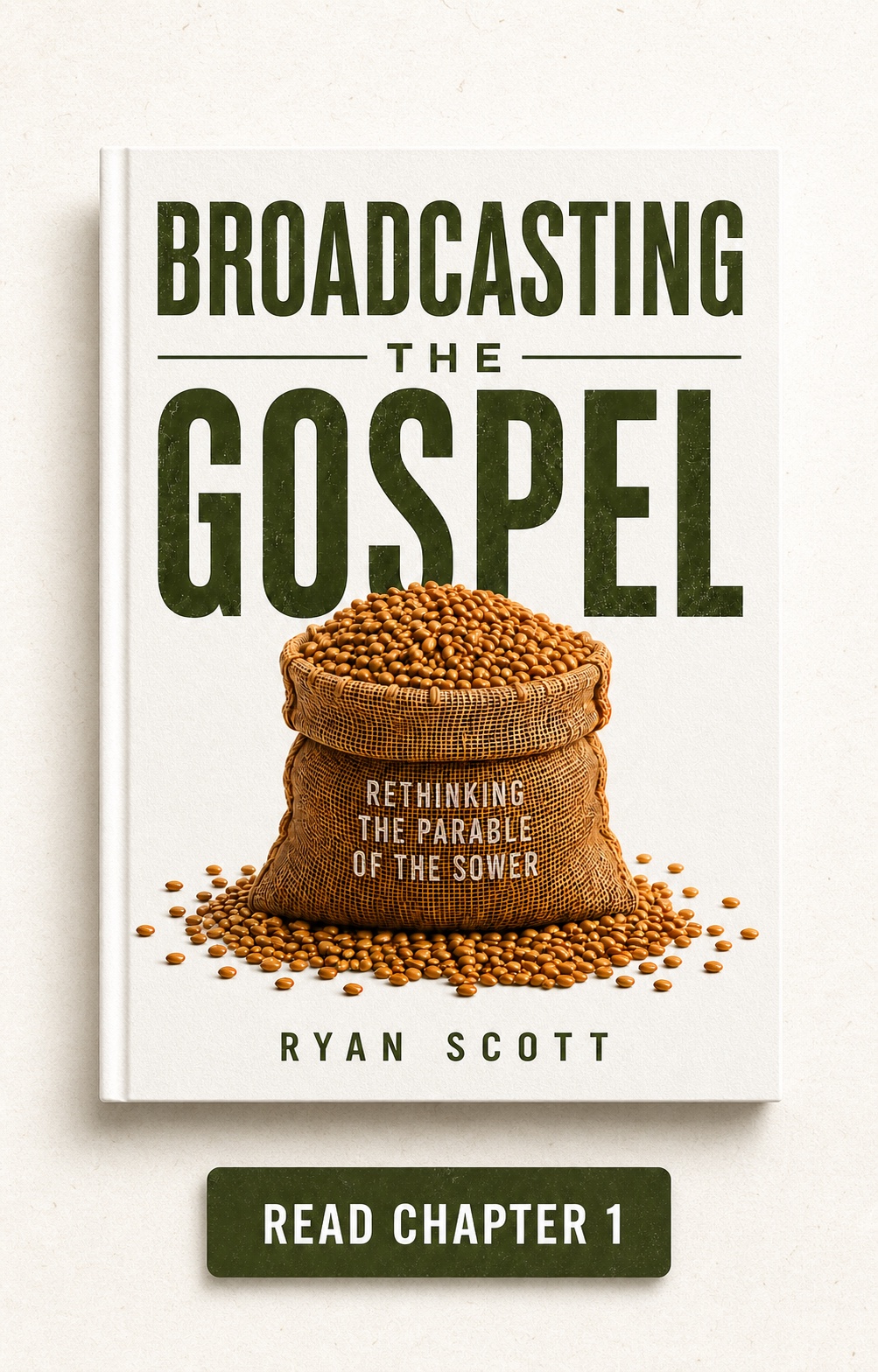
If the argument gets hold of you the way it got hold of me, Broadcasting the Gospel: Rethinking the Parable of the Sower works through the whole case, including what a sustainable throwing rhythm looks like for a minister with no media team and no budget. The first chapter is free on the book page.

Recent Posts
-
 “Broadcast” was a farming word first, and it changes how you read Matthew 13
 -
 What broadcasting actually looks like in an ordinary week
 -
 The one ChMS report that tells you if people are actually connecting
 -
 Breeze vs ChurchTrac: Which One Fits a Smaller Church Better?
 -
 How to evaluate church management software for your size church