A verse opened up in my study one Tuesday morning in Seattle. I sat back in the chair with that feeling you get when a passage you have read a hundred times finally turns over and shows you its underside. Then the phone rang. By that afternoon the thought was gone, and I never got it back.
That was a seed. It hit the floor of my office and dissolved, and my field never received it.
I did that for thirteen years. Not out of carelessness, and not because I was too busy. I had simply never thought of those moments as seed, so nothing ever happened to them.
The argument, in six minutes
Matthew 13 opens with the sower going out to sow, and he throws on ground he never tested. The soils show up afterward, and the grading of them comes from Jesus rather than from the farmer. That ordering is sitting in plain sight in the first line, and it changes who the story is asking you to imitate. Six minutes on why:
The video closes by telling you to quit grading the ground and start throwing. Agreeing with that on a Sunday afternoon costs nothing. Acting on it by Tuesday is the part nobody walks you through, because at four in the afternoon your sermon is unfinished, someone you love is in the hospital, and your phone is face down on the desk where it has been all day.
This is that part.
You already have more seed than you can carry
“I have no idea what I would post” is the most common thing ministers say to me when this comes up. It sounds like a content problem, and the feeling is fair, because most of us were never trained to sit down and manufacture ideas on demand, week after week.
But you are not starting from zero. You spend a dozen or more hours a week in the Word, then carry what you learned into prayer and the lives of people facing their worst weeks. Professional creators often have to search for source material. Ministry gives you more of it than you can publish. Most of what happens in your week never leaves the room it happened in, because nobody ever framed it as seed.
A social media teacher I heard at a conference put it in a way that has stuck with me ever since: you don’t have to create content, you have to document it. That reframe takes most of the weight off the task, because creating means conjuring something from nothing, and documenting only asks you to notice what is already there.
Your best illustration, the one that made the whole room lean forward last month, already exists. You already delivered it. It reached the people in the room, and then it stopped, and it did not have to.
What one week of throwing looks like
A verse hits you in study on Tuesday morning. You pick up the phone, look into it, and say “I was studying this morning and something got hold of me,” and then you talk for sixty seconds without a script or a second take. That is one cast.
Wednesday you leave the hospital and sit in the truck for a minute before you turn the key, because what you just walked out of is still sitting on your chest. That minute may matter more to a stranger at two in the morning than something polished you spent hours making. Record it before you drive away.
Sunday, after the service, while people are still visiting behind you, step to the side and shoot a two-minute version of what you just preached for forty-five. We did this constantly in Seattle. It required no additional preparation, because the preparation had already happened.
That is three casts in a week, from work you were doing anyway, on equipment already in your pocket. Do that for a year and you have roughly 150 throws in the ground that will still be working two years from now, while the year spent waiting on better gear puts nothing in the field. Talent and knowledge matter, but in an ordinary week your Cast Count usually rises when you pick up the phone more often.
Which platform this belongs on, and how to build a rhythm your people can sustain, is most of what I write about here. None of it is load-bearing until something gets recorded.
What Cast Count measures
Cast Count is the framework I use, and it exists because the number we usually reach for is the wrong one. “How many are you running?” measures what God is doing with your effort. It says very little about whether you were faithful this month.
A cast is one throw, which means a posted video counts the same whether it drew 12 views or 3,000. So does a fifteen-minute Facebook Live, or a prayer with a stranger in a parking lot. You count them monthly and the number resets, because a strong March says nothing about whether you are in the field today. A low number usually is not a strategy question or an equipment question. It is worth asking how many times you actually got into the field that month.
Seeds are different from casts. A seed is a touch point, one moment where the Gospel makes contact with someone who does not have it, so a video that reaches 300 people is one cast and 300 seeds. Those you count cumulatively across everything you have ever published, because broadcasting compounds. Our Seattle videos still draw hundreds of views a year after we left the city, from a field we are no longer standing in.
Paul planted, Apollos watered, and God gave the increase in 1 Corinthians 3:6-8. Notice what Paul says about the reward: each will receive according to his own labor, not according to the harvest. If your worth is measured by whether you threw, the video with eleven views has no power over you. Neither does the peer who thinks it was beneath you.
Fear of looking foolish
Fear of looking foolish sits underneath many of the reasons I hear for not doing this, and underneath the ones I used myself for thirteen years. Time and money matter, but in many cases the tools and distribution are already in your pocket. The harder part is facing what might happen after you post.
Some of that is peer pressure wearing a theological costume. Your colleagues are publishing careful teaching on Melchizedek and covenant theology, and you are about to post sixty seconds telling a stranger that God sees her. It can feel like a demotion. But the woman who searched “does my husband still love me” at midnight is not looking for your covenant series. She needs milk, and the content that feels too simple for your peers is often exactly what reaches the people nobody else is reaching.
The first time you talk into a camera may feel impossible. I have watched preachers who can hold a full room come completely undone by a phone on a tripod, and it wears off the same way it wore off the first time you preached.
Where to start
Post one video this week, and talk about whatever got hold of you in study on Tuesday. Then leave the views alone.
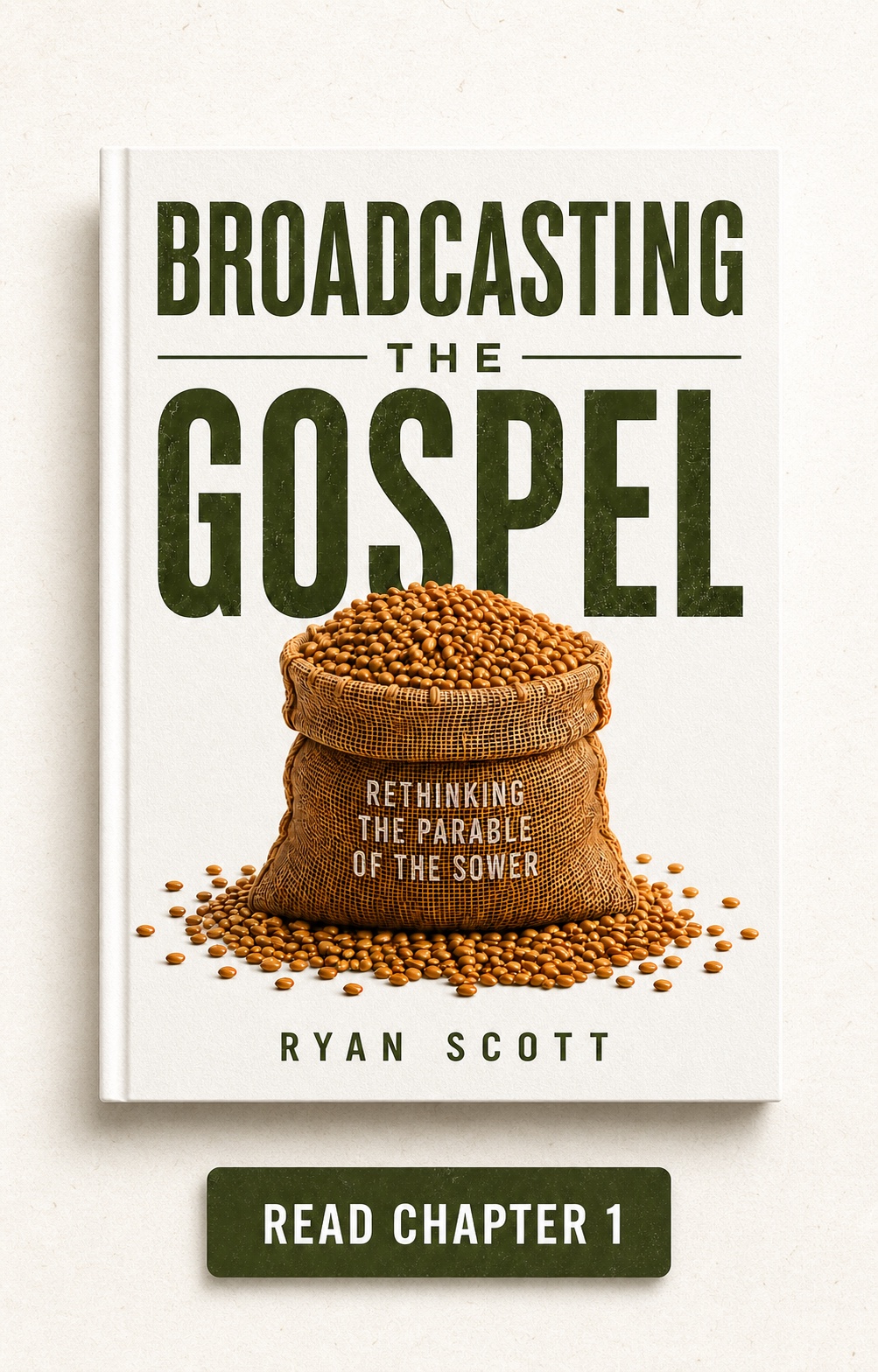
I wrote Broadcasting the Gospel: Rethinking the Parable of the Sower because I spent thirteen years believing all of this and still stopped planting, and I would rather you not lose the years I lost. It works through the whole argument from Matthew 13 and lays out Cast Count in full, with enough of a platform primer to get your first seeds into the ground.
Whatever you do with the book, the throwing is still yours to do.
Recent Posts
-
 “Broadcast” was a farming word first, and it changes how you read Matthew 13
 -
 What broadcasting actually looks like in an ordinary week
 -
 The one ChMS report that tells you if people are actually connecting
 -
 Breeze vs ChurchTrac: Which One Fits a Smaller Church Better?
 -
 How to evaluate church management software for your size church