Many small-church pastors end up carrying the sound system because no one else feels ready to touch it. They set levels before the service, preach with one ear on the speakers, and hope nothing changes once the service begins.
The barrier is rarely a lack of concern. It is the absence of a simple training path. The sound board looks technical, the service feels high stakes, and the pool of obvious volunteers seems small.
You do not need to find a professional audio engineer before you build a sound team. You need a clear training path for faithful people who can learn one skill at a time. That is a leadership task before it is a technical task.
Recruit for faithfulness before technical skill
Volunteer training path
Good sound volunteers usually begin as reliable people, not audio experts. They show up when they say they will. They can follow a process. They are willing to receive correction without taking it as personal rejection. Those traits will carry a volunteer further than a strong opinion about microphones.
Technical experience can help, and you should receive it with gratitude when it appears. A person who has mixed live events or worked with recorded music may bring useful knowledge. The caution is that experience alone does not build a team. If one knowledgeable person becomes the only person who can operate the system, the church has simply moved the bottleneck from the pastor to another individual.
Look for people who are calm under mild pressure. A retired teacher, a detail-oriented college student, a parent who already arrives early, or a steady deacon may be a better first recruit than the person who talks most confidently about gear. Sound ministry rewards attention, patience, and consistency.
Invite people into the purpose before you invite them into the equipment. Tell them the work matters because people need to hear Scripture, prayer, and song without distraction. A volunteer who understands the ministry value of the role will learn the technical pieces with more endurance.
Define the role in plain language
A volunteer needs to know what success looks like before they agree to serve. If the role sounds like “make everything sound professional,” many capable people will quietly step back. If the role is described as “help the room hear clearly and follow a simple process,” the work becomes more approachable.
Write a short role description in ordinary language. The sound volunteer arrives early enough to power on the system, checks the microphones, sets starting levels, follows the service order, responds calmly if something changes, and powers the system down afterward. That is already enough for a beginner.
Avoid making the first version of the role too broad. Do not ask a new volunteer to manage livestream audio, troubleshoot every cable, shape the worship mix, record the sermon, and train the next person all at once. Those may become future responsibilities, but they are not the starting line.
Plain language also protects the pastor from overexplaining. You do not need to teach the history of audio systems in the first conversation. You need to tell a potential volunteer what they will do, how they will be supported, and why their service matters to the church.
A four-week sound volunteer path
Teach signal flow before everything else
Signal flow gives a volunteer a mental map of the system. A voice enters the microphone, travels through a cable or wireless receiver, reaches the mixer, leaves the mixer, and comes out of the speakers. Once a volunteer understands that path, troubleshooting becomes less mysterious.
Walk the path physically. Start at the microphone. Follow the cable with your hand. Show where it enters the mixer. Point to the channel number. Show the fader that controls that channel. Then point to the main output and the speakers. This may feel too simple, but it gives a new volunteer the confidence to ask better questions.
Most sound problems become less intimidating when the volunteer can ask, “Where did the signal stop?” If the microphone has no battery, the signal never begins. If the cable is unplugged, it stops before the mixer. If the channel is muted, it reaches the board and goes no further. If the main fader is down, every channel can look correct while the room hears nothing.
This is the kind of knowledge that makes a volunteer useful quickly. They do not need to understand every frequency range on the first day. They need to know the route the sound takes and the few places where that route commonly breaks.
Start with gain instead of tone
Gain is the first technical skill worth teaching because it affects almost everything else. Gain sets the strength of the incoming signal before the volunteer adjusts the fader for the room. When gain is set reasonably, the rest of the mix becomes easier to manage.
Show the volunteer how to set gain during soundcheck. Have the speaker or singer use the microphone at the same volume they will use during the service. Bring the gain up until the signal is healthy, but not distorted. Then set the fader to a normal working position and adjust from there.
Keep the explanation simple at first. Too little gain can make the sound weak or noisy. Too much gain can create distortion or feedback. A good starting point gives the volunteer room to make small fader adjustments without fighting the system.
Do not begin with EQ if the volunteer is brand new. Equalization can be useful, but it is easy to overuse when someone does not yet understand levels. Many small church mixes improve immediately when the gain is reasonable, the microphone is placed well, and the fader balance is steady.
Make training hands-on and low pressure
Sound is learned by hearing changes in real time. A manual can explain what a knob does, but a volunteer learns faster when they move the knob and hear the result in the room. That makes rehearsal and practice time more valuable than long explanations.
If your church has a midweek rehearsal, use part of it as training time. Let the new volunteer arrive early and practice with one microphone before anyone else is depending on the system. Ask them to mute and unmute the channel, move the fader, set a basic level, and listen from different parts of the room.
If you do not have a midweek rehearsal, create a short monthly practice. Set up two microphones and one speaker. Let volunteers practice turning the system on, checking a microphone, making a voice louder, muting a channel, and shutting everything down in the correct order. Thirty focused minutes can remove a great deal of Sunday anxiety.
Low-pressure practice also gives volunteers permission to make mistakes while no congregation is watching. They can hear feedback, learn what caused it, and fix it without embarrassment. They can forget a step and repeat it. They can ask the question they might be afraid to ask on Sunday morning.
Create a one-page reference sheet
A reference sheet gives new volunteers a safety net. It does not need to explain the whole system. It should list the steps they need to follow before, during, and after the service. One clear page is better than a binder no one opens.
Start with the power sequence. Many systems behave better when equipment is turned on and off in a consistent order. Write that order plainly. If speakers should turn on last and turn off first, say that. If a mixer should stay at a certain level when the system starts, write it down.
Include the normal channel list. For example, channel one may be the pulpit microphone, channel two may be the pastor’s wireless microphone, channel three may be the worship leader, and channel four may be the keyboard. Use the names your volunteers already use. A clear label beats a technically perfect phrase that no one remembers.
List the first response to common problems. If feedback happens, lower the fader first and troubleshoot second. If there is no sound, check mute buttons, cable connections, batteries, and the main fader. If the pastor’s microphone sounds weak, make sure it is positioned correctly before changing several settings.
Laminate the sheet if you can. Tape a copy near the mixer. Put another copy in the equipment bag if your church is portable. A written process reduces the burden on memory, and memory is often the first thing to fail when a volunteer feels pressure.
Use shadowing without making it complicated
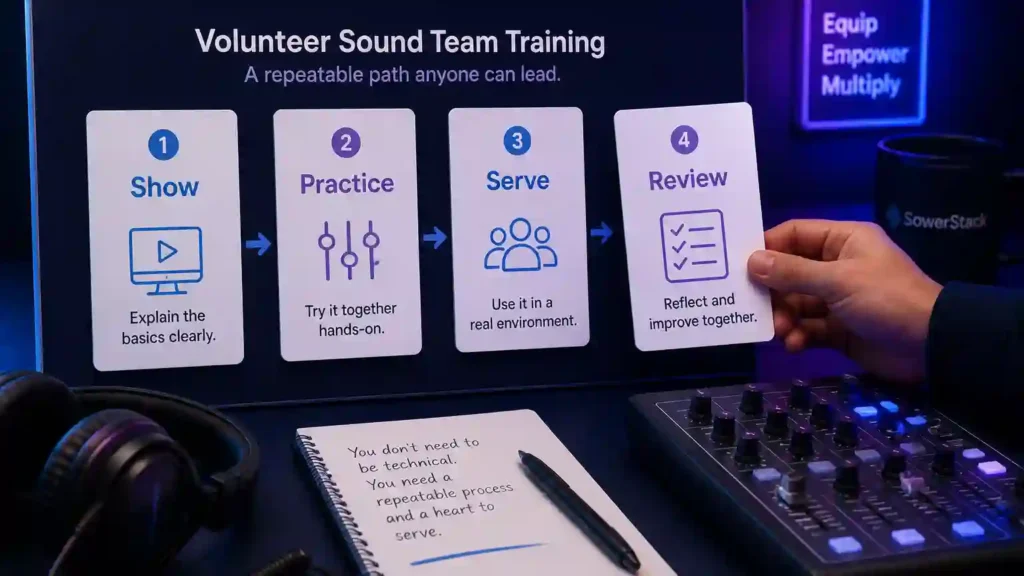
Shadowing works when the new volunteer is allowed to grow in responsibility gradually. They begin by watching, then they help, then they lead with support before serving on their own. That progression feels slow to a pastor who wants relief, but it builds confidence that lasts.
During the first week, the new volunteer should sit or stand beside the experienced person and simply observe. They should notice when microphones are muted, when levels change, and how the sound person follows the service order. Observation gives context before responsibility.
During the next service or rehearsal, give them small tasks. They can mute the worship leader after the song set, bring the pastor’s microphone up before the sermon, or check batteries before the service. These tasks are meaningful but manageable.
After that, let them run the system while someone experienced stands nearby. The experienced person should resist the urge to take over unless something is about to disrupt the service. Quiet coaching is better than constant correction. A volunteer cannot grow if every decision is immediately second-guessed.
By the time they serve alone, they should know who to call if they need help. That final detail matters. A volunteer who knows support is available will serve with more calm than one who feels abandoned at the board.
Build a culture that can survive mistakes
Every sound volunteer will make a mistake. A microphone will be muted when it should be live. A fader will come up too late. Feedback will interrupt a quiet moment. These things are not ideal, but they are normal in live ministry with volunteers.
The pastor’s response teaches the church how to treat people who serve. Visible frustration from the stage may feel understandable in the moment, but it tells every future volunteer that serving in technical roles carries the risk of public shame. That is too high a cost for most people.
Correct privately and specifically. Thank the volunteer for serving. Name what happened without exaggeration. Explain the next step. “Before the sermon, check that the wireless channel is unmuted and the battery light is still strong.” That kind of correction is clear enough to help and kind enough to preserve courage.
Celebrate progress more often than you mention problems. A sound volunteer who made the service clearer should hear that their work mattered. Mention the team occasionally from the front. Send a short note after a difficult Sunday. People who serve invisibly need reminders that the ministry sees them.
A healthy culture will produce better sound over time. Volunteers stay longer when they are treated with dignity. They ask better questions when they are not afraid of being embarrassed. They become more careful when correction feels like discipleship rather than punishment.
Know when outside help is wise
Outside help can be a good stewardship decision when it gives your volunteers clarity they cannot easily gain on their own. You do not need a professional on payroll to benefit from professional knowledge. A half-day training session may be enough to move your team forward.
Bring in a local audio technician if the system has routing nobody understands, if feedback is frequent, or if volunteers are afraid to touch the board because past changes created confusion. Ask the technician to explain the system, label the important paths, remove unnecessary complexity where appropriate, and train the volunteers on the basic Sunday workflow.
You can also hire someone for one rehearsal or one Sunday to observe your team. Their job is not to replace your volunteers. Their job is to help your volunteers hear the room, improve the setup, and identify habits that will make the service more consistent.
Training events can help when they fit your people and your equipment. A regional workshop may give volunteers confidence and language for what they are already doing. The best training returns them to your church with practical next steps, not a list of gear they feel pressured to buy.
Connect the sound team to pastoral care
Sound ministry is not separate from pastoral care. People hear the sermon through the work of the sound volunteer. They follow the Scripture reading because a microphone was ready. They sing with more confidence when the room supports the congregation rather than fighting it.
That does not make sound the center of worship. It means the technical work serves the human work. A volunteer at the board is helping remove avoidable barriers so the church can participate. That is a meaningful act of service.
Pastors can strengthen the team by explaining this connection often. The sound volunteer is not merely handling equipment. They are serving the gathered church. They are helping visitors hear the gospel clearly. They are supporting the people who lead prayer, song, and preaching.
When volunteers understand the spiritual weight of the task, they are more willing to practice. They show up early for a reason beyond the checklist. They care about doing the work well because the work is attached to people, not machines.
Keep the pathway simple enough to repeat
A sound team grows when the training pathway is simple enough for one volunteer to pass it to another. If every new person requires the pastor to explain everything from the beginning, the system remains fragile. If trained volunteers can use the reference sheet and shadowing process to train the next person, the ministry becomes more sustainable.
Review the pathway after the first few volunteers are trained. Ask what confused them. Ask which steps helped. Ask where the reference sheet needs clearer wording. The people who just learned the role are often the best source of improvement because they still remember what felt uncertain.
Keep the process modest. Recruit faithful people. Teach the signal path. Practice the basic controls. Use a one-page reference sheet. Shadow gradually. Correct with dignity. Bring in help when it would save months of confusion. That is enough structure for many small churches to build a team that serves well.
You are not trying to create a technical department. You are trying to help people serve the church with competence and peace. That is much closer to the pastoral work you already know than it may first appear.
Faithful systems protect people
A pastor should not have to run sound from the pulpit forever. A volunteer should not have to guess their way through a service with no training. A congregation should not have to treat clear audio as a luxury only larger churches can expect.
Faithful systems protect people from carrying what should be shared. A simple training path protects the pastor’s attention. It protects volunteers from fear. It protects the congregation from avoidable distraction. The technology matters because people matter.
If your church has been depending on one person to make every sound decision, start with the next faithful step. Write the role in plain language. Invite one teachable person to shadow. Build one reference sheet. Practice one skill before adding another.
We help churches think about digital and technical tools as servants of ministry, not as replacements for ministry. A sound team is a clear example of that principle. The goal is not a flawless production. The goal is a room where people can hear, respond, and participate with fewer barriers.

Recent Posts
-
 “Broadcast” was a farming word first, and it changes how you read Matthew 13
 -
 What broadcasting actually looks like in an ordinary week
 -
 The one ChMS report that tells you if people are actually connecting
 -
 Breeze vs ChurchTrac: Which One Fits a Smaller Church Better?
 -
 How to evaluate church management software for your size church