A church of forty people met in a rented community center for three years with one powered speaker and a wireless karaoke microphone from Amazon. The pastor’s voice cut in and out during sermons. The worship leader plugged a guitar into the same speaker through a small splitter cable. When the church sang, half the room could not hear the words clearly.
Nobody was being careless. They were trying to be faithful with what they had. They assumed clear sound required a large budget, a trained audio person, and a setup that belonged in a concert venue. Since they had none of those things, they made do.
Then one Sunday a visitor sat near the back and asked a simple question after the service: “Is there a way to hear the sermon online? I missed parts of it in the room.” The pastor heard the question for what it was. The issue was not polish. The issue was whether people could hear Scripture, prayer, and invitation without fighting the room.
A thousand dollars will not build a professional venue. It can build a clear, reliable sound system for a small church gathering in a room of roughly 50 to 150 people. That is a worthy ministry investment because clear audio serves people before it impresses anyone.
What a $1,000 church sound system should accomplish
What the $1,000 budget needs to cover
| Category | What it solves | Budget posture |
|---|---|---|
| Speakers | Room coverage and intelligibility | Buy dependable, not oversized |
| Mixer | Control over microphones and sources | Keep it simple enough for volunteers |
| Microphone | Clear voice at the source | Choose proven live speech gear |
| Cables and stands | Reliability and safe setup | Do not starve the small pieces |
A basic church sound system should make spoken words intelligible, support simple music, and remain easy enough for a volunteer to operate without fear. That is the target. Anything beyond that can be useful later, but it should not distract you from the first responsibility.
For many small churches, the sound problem is not that the system lacks professional features. The problem is that the voice source, mixer, speakers, and room are not working together in a simple path. When that path is clear, the room changes. People stop straining. Volunteers stop guessing. Visitors hear what is being said.
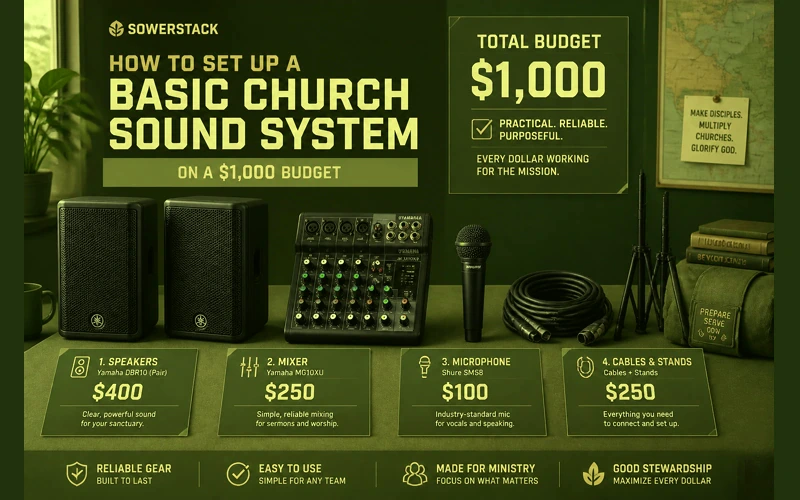
The system needs four equipment categories. You need powered speakers to amplify sound into the room. You need a mixer to combine microphones and other sources. You need microphones that suit speech and simple vocals. You need the cables, stands, and small accessories that make the system stable.
Those supporting pieces are not afterthoughts. A good microphone with a weak cable will still fail at the worst moment. A clear speaker sitting on the floor will still send sound into chairs instead of ears. A mixer placed where no one can hear the room will produce a mix based on guesswork.
A simple sound path
Put the largest share of the budget into speakers
Speakers determine how much of your careful work actually reaches the room. A good microphone through a clear mixer can still sound thin, harsh, or muddy when the speakers are not suited for the space. The speaker is the final voice of the system.
Powered speakers are the best fit for most small churches starting from scratch. A powered speaker has the amplifier built in, so you do not need a separate power amp or extra decisions about matching equipment. You run a signal cable from the mixer to the speaker, plug the speaker into power, and begin with fewer points of failure.
For a $1,000 system, two Yamaha DBR10 powered speakers are a strong first choice. They usually cost around $300 each. They are 10-inch, two-way powered speakers with enough output for many small worship rooms. They handle speech well and provide enough fullness for acoustic guitar, keyboard, and simple vocals.
The Yamaha DBR10 is not the only reasonable option. The QSC CP8 is another excellent small powered speaker, especially for rooms under about 80 people. It is compact, clear, and well built. The Yamaha CBR10 can also make sense if you already own a suitable amplifier, but for a new system, powered speakers usually simplify the whole setup.
Do not choose speakers by wattage numbers alone. Manufacturers describe power in different ways, and a larger number does not automatically mean better clarity. Listen for speech intelligibility, coverage, and reliability. Your people need to hear the words more than they need to feel impressed by a specification.
Speaker stands matter almost as much as speaker choice. When speakers sit on the floor, the first rows and furniture absorb the sound. When they are lifted so the high-frequency driver is near seated ear height or slightly above, speech becomes clearer for the whole room. That is a modest purchase with a large practical effect.
Choose a mixer your volunteer can understand
The mixer should give you enough control without making Sunday morning feel like a technical exam. A compact analog mixer is often the right starting point because the controls are visible, physical, and easy to explain. A new volunteer can see one channel, one gain knob, one fader or level knob, and one main output.
The Yamaha MG06 is a good fit for a very simple system. It gives you two microphone inputs and several line inputs for a laptop, keyboard, or other source. It is small, dependable, and clear enough for spoken word and simple music. At around $120, it leaves room in the budget for speakers and accessories.
If you can spend slightly more, the Yamaha MG10 gives you additional channels and a little more room to grow. That can be useful if your Sunday setup may soon include another microphone, a regular laptop source, or an instrument. The goal is not to buy more knobs for their own sake. The goal is to avoid replacing the mixer the first time your Sunday setup expands modestly.
A church using two microphones with a laptop source and one instrument does not need a large digital mixer on day one. Digital boards can be excellent, but they require training and bring features you may not need yet. If the people serving have to search through menus to solve a simple problem, the system may be more capable than useful.
The best mixer for this budget is the one your church can operate consistently. If a volunteer can turn it on, check a microphone, set a healthy level, and respond calmly when something changes, the mixer is serving ministry well.
Buy microphones for real church use
Church microphones live in ordinary conditions. They are handled by people who may not know audio etiquette. They get placed on tables, dropped into bags, passed between volunteers, and used in rooms that were not designed for sound. Durability and feedback resistance matter.
The Shure SM58 remains one of the safest choices for a primary vocal microphone. It usually costs around $100, sounds clear on many voices, rejects feedback reasonably well, and survives years of normal church use. There is a reason so many sound people recommend it when someone asks for one dependable live vocal microphone.
For a second microphone, the Shure SM48 can make sense at around $50. It is less expensive than the SM58 but still useful for speech, announcements, backup vocals, or a second speaking position. If the budget allows two SM58s, that is a fine choice. If you need to preserve money for cables and stands, one SM58 and one SM48 is a practical combination.
Dynamic microphones are usually the right starting point. They do not require phantom power, they are less sensitive to the whole room, and they tend to handle live sound more forgivingly than many condenser microphones. In a small room with reflective walls and volunteers learning the system, forgiving equipment is a gift.
Wireless microphones are convenient, but they are not where this budget should begin unless mobility is essential. A reliable wireless channel from a trusted brand can cost several hundred dollars. A cheap wireless system may create interference while bringing battery problems and thin sound. A wired microphone with a good cable is less glamorous and more reliable.
Do not let cables and stands become the weak point
Cables and stands are easy to forget because they are not exciting purchases. They are also the pieces that often decide whether the system works smoothly. A church can own good speakers and still lose sound because a bargain cable crackles every time someone moves.
Plan for two 25-foot XLR cables for microphones. Hosa, Pro Co, and similar practical brands are usually sufficient for small church use. You do not need luxury cables, but you should avoid mystery cables that cost less than lunch. A cable that lasts several years is cheaper than a cable you replace repeatedly.
You also need two signal cables from the mixer to the powered speakers. Depending on your mixer and speakers, those may be XLR cables or 1/4-inch TRS cables. Use balanced cables when the run is long enough to cross the room. Balanced connections reduce noise and help the system behave more predictably.
Two microphone stands will cover many basic setups. Boom stands are useful because they can place the microphone near a pulpit or music stand without awkward positioning for the speaker. Two speaker stands will lift the speakers where they can cover the room more evenly.
Small accessories deserve a little attention. A roll of gaffer tape can secure cable runs without leaving the sticky mess of duct tape. A few spare microphone clips can save a Sunday morning. A simple storage bin or cable bag helps volunteers put things away in the same place each week.
A practical $1,000 build
A thoughtful build can stay near $1,000 if you keep the purpose clear. Prices move, so treat this as a responsible starting point rather than a permanent quote. The exact model may change, but the budget logic should remain steady.
Start with two Yamaha DBR10 powered speakers at roughly $600 for the pair. Add a Yamaha MG06 mixer at roughly $120, or choose the MG10 if you can add a little more for future inputs. Use a Shure SM58 for the main vocal or preaching microphone and a Shure SM48 for the second microphone, which puts the microphone cost near $150.
Reserve about $130 for cables and stands. That includes two microphone cables, two speaker signal cables, two microphone stands, and two speaker stands. If prices run higher, protect the quality of the speakers and the reliability of the cables before you chase a nicer accessory.
This system will not cover every church situation. It will not serve a large room with a full band and complex monitoring needs. It will serve many small churches that need speech clarity, simple worship support, and a system a volunteer can understand. That is the assignment.
Set up the room before you touch the knobs
Speaker placement shapes the result before the mixer does anything. Put the speakers near the front of the room, one on each side, slightly forward of the main microphone position when possible. This helps reduce the chance that the microphone hears the speaker and turns that loop into feedback.
Raise the speakers so the high-frequency driver points toward the people who need to hear. Aim them slightly inward rather than straight at the side walls. If the room is narrow, keep the angle modest. If the room is wide, spread the speakers enough to cover the seating without blasting the first row.
The mixer should sit where the volunteer can hear something close to what the room hears. The back of the room is often best. A side position can work if the volunteer can walk the room during soundcheck. A mixer on the platform is convenient for cabling but difficult for listening because the platform hears a different balance than the people seated in the room.
Run cables neatly and safely. Avoid paths where people walk. If a cable has to cross a walkway, tape it down with gaffer tape or cover it properly. A clear room is part of faithful preparation. Sound ministry should remove distractions, not create new hazards.
Use a simple power and soundcheck process
A consistent process protects volunteers from guessing. Turn the mixer on first and the powered speakers on last. When shutting down, turn the speakers off first and the mixer off last. This reduces loud pops and protects the equipment from avoidable stress.
Set the main output to a reasonable starting position, then bring each microphone channel up one at a time. Have someone speak at normal preaching or announcement volume from the place they will actually stand. Do not set levels while someone whispers into a microphone from two feet away. Soundcheck should resemble Sunday use.
Start with the gain knob. Bring it up until the mixer shows a healthy signal without clipping. Then use the channel level and main output to set the room volume. If the mixer has a simple EQ, make small moves. A little less low end can reduce boominess. A slight high-frequency lift can help speech, but too much can make the voice harsh.
Walk the room while someone speaks. Listen from the front, middle, back, and sides. The goal is not identical sound everywhere. The goal is that every seat can hear words clearly without strain. If the back row cannot understand speech, the system is not yet serving the room.
Know what this budget leaves for later
A $1,000 sound system is a faithful starting point, not the final word on church audio. Knowing what you are leaving for later helps you avoid frustration. It also helps you explain the decision to people who compare your setup with a larger church online.
You probably will not have wireless microphones at this budget. That is acceptable for many churches. Wired microphones are reliable, inexpensive, and easy to troubleshoot. If your pastor truly needs to move through the room while speaking, plan a future wireless purchase from a dependable brand rather than squeezing in a fragile wireless system now.
You probably will not have monitor speakers. In a small room with simple music, the people leading may be able to hear enough from the room itself. If your worship becomes more complex, a monitor or in-ear solution may become worthwhile. That can come after the room hears clearly.
You probably will not have a subwoofer. For speech and acoustic music, that is usually fine. A subwoofer becomes more important when low-frequency content becomes a regular part of the service. Even then, it should serve the room rather than overpower it.
You may not have sermon recording through the mixer. If recording is important, a mixer with USB output may be worth the extra cost. The Yamaha MG10XU or similar models can send audio to a computer more easily. That upgrade makes sense when the sermon needs to serve people beyond the room.
Pay attention to the room itself
The room is part of the sound system whether you budgeted for it or not. Hard walls and bare glass can make speech bounce, especially when tile floors or low ceilings add more reflection. A better speaker can help, but it cannot repeal the behavior of the room.
Look for simple acoustic improvements before assuming you need more gear. Rugs, curtains, padded chairs, bookshelves, and modest acoustic panels can reduce reflections. You do not need to turn the worship space into a studio. You need to soften the surfaces that make speech harder to understand.
Listen especially for echo and muddiness. If a person speaks and the room keeps talking after they stop, reflections are competing with the next word. If consonants disappear, people may hear volume without clarity. In preaching, clarity is the work.
A portable church may have fewer options, but even then, placement matters. Try different speaker positions during setup. Keep microphones behind the front edge of the speakers. Avoid aiming speakers at glass or bare walls when another angle would serve the seating better.
Build for the next faithful step
The first thousand dollars creates the foundation. The mixer, microphones, stands, speakers, and cables can keep serving when later upgrades become wise. A thoughtful first system is not money thrown away. It is the beginning of a path.
That matters for stewardship. Churches often delay helpful improvements because the ideal version feels out of reach. Meanwhile, people keep straining to hear. A better approach is to solve the real problem in front of you and leave room for wise growth later.
Clear sound is not vanity. It is hospitality. It is care for older members who struggle to hear, visitors who are already taking in an unfamiliar room, children who need instructions, and volunteers who lead prayer or song. When the church can hear clearly, the gathered body participates with less friction.
If your current setup is doing its best but not serving the room well, begin with assessment. What must people hear every Sunday? Where are they struggling to hear it? Which part of the sound path is weakest? Answer those questions before buying anything.
We help churches think about tools as servants of ministry. A basic sound system is one of the clearest examples. The goal is not to look impressive. The goal is that when Scripture is read, prayers are offered, and the gospel is proclaimed, the people in the room can hear.
Recent Posts
-
 “Broadcast” was a farming word first, and it changes how you read Matthew 13
 -
 What broadcasting actually looks like in an ordinary week
 -
 The one ChMS report that tells you if people are actually connecting
 -
 Breeze vs ChurchTrac: Which One Fits a Smaller Church Better?
 -
 How to evaluate church management software for your size church