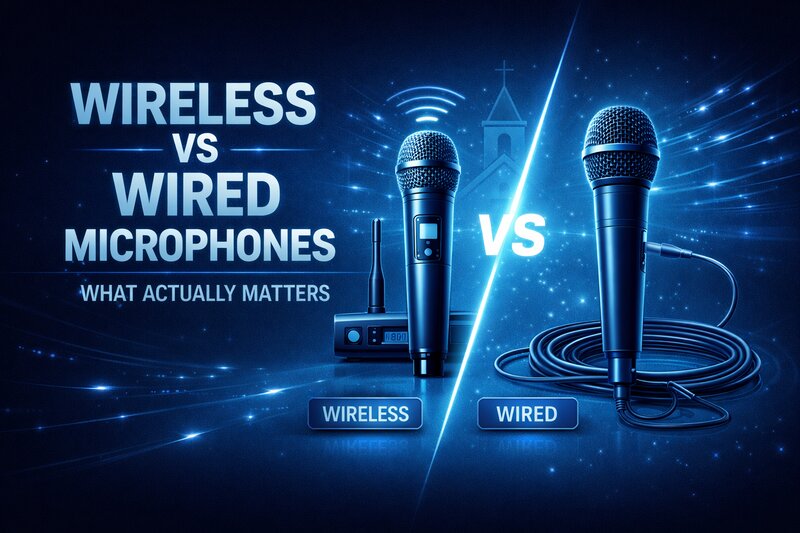
A worship leader at a 120-member church spent $800 on a wireless microphone system last year. Six months later, it sits in a drawer. The batteries kept dying mid-sermon, and the interference from a nearby radio tower made Sundays unpredictable. She went back to the $90 wired mic that had been working fine the whole time.
Down the road, a pastor at a church half that size uses a wireless headset every week. He moves through the room while he preaches, stops at the edge of the stage to pray with someone, walks among the chairs during the invitation. That freedom changed how his church experiences the sermon. The wireless system was worth every dollar.
Same technology. Same price range. Completely different outcomes.
The difference had nothing to do with which type of microphone was “better.” It had everything to do with which one matched how each leader actually leads.
The question most churches skip
When a church starts shopping for microphones, the conversation usually begins in the wrong place. Someone asks what brand to buy, or what the church down the street uses, or what the sound guy recommends. Those aren’t bad questions, but they skip the one that matters most.
How does your pastor or worship leader actually move during a service?
A pastor who preaches from behind a pulpit every Sunday has fundamentally different needs than one who paces the stage, walks the aisles, or shifts between a music stand and a communion table. A worship leader who stands at a keyboard the entire set needs something different from one who moves between instruments, engages the congregation from the front of the stage, and occasionally steps away to lead prayer.
The microphone isn’t just a tool for amplification. It shapes how a leader occupies the room. And most churches choose based on features or price without ever asking what the room actually requires.
Where wired microphones still win
Wired microphones carry an unfair reputation. They seem old-fashioned, limited, like a compromise. But for a large number of churches, wired is the stronger choice. Not the budget fallback. The better decision.
Reliability is the first reason. A wired microphone has no batteries to die, no frequencies to conflict, no signal to drop. You plug it in, and it works. Sunday after Sunday. Year after year. For a church where the pastor stands at a pulpit or a lectern, that reliability is worth more than any feature a wireless system offers.
Sound quality at the same price point is the second reason. A $100 wired dynamic microphone from Sennheiser or Shure will outperform a $100 wireless system every time. The wireless version at that price has to split its budget between the microphone capsule, the transmitter, the receiver, and the battery system. Something has to give, and it’s usually the audio quality. A wired mic puts all of its engineering into one thing: capturing your voice well.
Simplicity is the third reason. Wired microphones don’t require frequency coordination, firmware updates, battery management, or troubleshooting invisible signal issues. For churches where one or two volunteers run sound on a rotating basis, that simplicity means fewer things go wrong on Sunday morning.
A good wired microphone in the $80 to $150 range will serve a church faithfully for a decade or more. The Sennheiser e835 and the Shure SM58 have been doing exactly that in churches around the world for years. They’re built to take abuse, they sound clean, and they don’t surprise you.
If your pastor preaches from a fixed position and your budget is tight, a quality wired microphone isn’t settling. It’s stewardship.
Where wireless becomes worth the investment
There’s a point where a wired microphone starts working against what a leader is trying to do. When a pastor moves, a cable becomes a constraint. When a worship leader shifts between a guitar, a keyboard, and the front of the stage, a wire becomes something to trip over. When a church does drama, reader’s theater, or children’s moments that involve movement, a cable tethers the moment to a single spot.
Wireless microphones solve a real problem. They give a leader the freedom to move naturally through a space without thinking about technology. That freedom can change the feel of a sermon, the energy of worship, the connection between the person speaking and the people listening.
But wireless freedom comes with real costs beyond the price tag.
Batteries are the most common frustration. Every wireless system runs on batteries, either disposable or rechargeable. Disposable batteries need to be fresh every Sunday, which means building a supply habit and accepting ongoing expense. Rechargeable systems solve the cost problem but introduce a charging discipline. If nobody puts the mic on the charger Saturday night, Sunday morning gets interesting.
Frequency management is the less visible challenge. Wireless microphones transmit on specific radio frequencies, and those frequencies can conflict with other devices, nearby buildings, cell towers, or even other wireless systems in your own building. The FCC has repeatedly changed which frequency bands are legal for wireless microphone use, most recently clearing the 600 MHz band for cellular carriers. Churches running older wireless systems on those frequencies have found their equipment suddenly unreliable or outright illegal to operate.
If you’re buying new wireless equipment today, make sure it operates in a frequency range that the FCC hasn’t earmarked for reallocation. The UHF range between 470 and 608 MHz is currently the safest window, but even that isn’t guaranteed permanently. Sennheiser and Shure both publish guidance on which of their systems operate in compliant ranges.
Interference is the problem you can’t always predict. A wireless system might work perfectly during a Thursday sound check and drop out during Sunday worship when the building is full of smartphones, Bluetooth devices, and Wi-Fi signals. Digital wireless systems handle this better than older analog ones, but no wireless microphone is immune to RF interference.
Cost scales differently than wired. A reliable wireless system starts around $200 to $300 for an entry-level digital system from a reputable manufacturer. A professional-grade system runs $500 to $1,000. A touring-quality system with advanced frequency management can push past $1,500. At every tier, you’re paying significantly more than a wired microphone of equivalent audio quality. You’re paying for the freedom, not the sound.
The problems churches actually face
Most wireless microphone problems in churches aren’t dramatic failures. They’re small, accumulating frustrations that erode trust in the system.
The mic cuts out for two seconds during the prayer. The handheld picks up a faint radio station during quiet moments. The bodypack transmitter’s clip breaks, and the mic slowly slides down the pastor’s shirt during the sermon. The batteries show “full” on the transmitter but the receiver shows “low.” The youth group borrowed the wireless mic for an event and nobody can find the receiver.
These aren’t failures of technology. They’re failures of systems. Wireless microphones demand a level of organizational discipline that wired microphones don’t. Someone needs to own the charging routine. Someone needs to track which frequencies are in use. Someone needs to maintain the equipment, check connections, replace worn clips and windscreens. In a church with a dedicated tech director, that’s straightforward. In a church where volunteers rotate through the sound booth, that discipline is hard to sustain.
This is worth being honest about. A wireless system that isn’t consistently maintained will cause more problems than a wired system that gets plugged in and forgotten.
Choosing by situation, not by preference
The most useful way to think about this decision isn’t “which is better” but “which matches our reality.” A few honest questions get you there faster than any product review.
Does your pastor or worship leader move during the service? If they stay in one spot, wired is almost certainly the right call. If they move regularly and intentionally, wireless earns its place.
How many volunteers manage your sound system, and how consistent is your setup routine? If you have a reliable team with consistent practices, wireless systems will get the care they need. If your sound setup depends on whoever shows up Sunday morning, wired microphones forgive inconsistency.
What’s your actual budget for the microphone and the ongoing costs? A wired mic is a one-time purchase. A wireless system is a one-time purchase plus batteries, plus eventual repairs, plus possible frequency migration if regulations change. Factor in the full cost of ownership, not just the sticker price.
Do you run multiple wireless devices simultaneously? Each additional wireless microphone or in-ear monitor in your building increases the complexity of frequency coordination. Two wireless mics in a small room are manageable. Six wireless channels in a building near a cell tower require careful planning and possibly a frequency coordinator.
Making the right investment at each price point
For churches working with limited resources, here’s how the options actually break down.
Under $150: Wired is the clear choice. At this price, you can get a professional-quality dynamic microphone that will last for years. Wireless systems at this price point cut too many corners to be reliable for weekly use.
$200 to $400: Entry-level digital wireless systems become viable. Sennheiser’s XSW-D series and Shure’s BLX line both offer solid performance at this range. These are good enough for a single wireless channel in a small to mid-size room with manageable RF conditions. A wired mic at this price is excellent, so the choice comes down to whether you need the mobility.
$500 to $1,000: This is where wireless systems start to feel genuinely professional. Frequency agility improves, build quality gets more robust, and audio quality approaches wired equivalents. Sennheiser’s EW-D series and Shure’s SLX-D series live in this range. For churches that need wireless and want reliability, this tier is where the investment starts paying consistent dividends.
Above $1,000: Professional touring-grade systems with advanced spectrum management, networked control, and exceptional audio quality. Most churches don’t need this unless they’re running multiple wireless channels in a challenging RF environment. But for those that do, systems like Sennheiser’s EW-DX or Shure’s Axient Digital provide the kind of reliability that removes wireless from the list of things you worry about on Sunday.
Sweetwater’s sales engineers are worth calling at any budget level. They specialize in helping churches navigate these decisions, and they’ll tell you honestly when a wired mic is the better choice for your situation.
What actually matters
The microphone conversation in churches gets complicated because we conflate the tool with the outcome. A wireless system doesn’t make preaching better. A wired system doesn’t limit a ministry. The right microphone is the one that disappears during the service, the one nobody in the room thinks about because it’s just working.
For some churches, that’s a $90 wired dynamic mic clipped to a pulpit stand. For others, it’s a $700 wireless headset that lets the pastor move freely through the room. Both are faithful choices when they match the ministry happening in that space.
The goal was never to own the best microphone. The goal was to make sure the people in the room can hear the message clearly. Whatever gets you there reliably, week after week, is the right choice for your church.


Recent Posts
-
 “Broadcast” was a farming word first, and it changes how you read Matthew 13
 -
 What broadcasting actually looks like in an ordinary week
 -
 The one ChMS report that tells you if people are actually connecting
 -
 Breeze vs ChurchTrac: Which One Fits a Smaller Church Better?
 -
 How to evaluate church management software for your size church