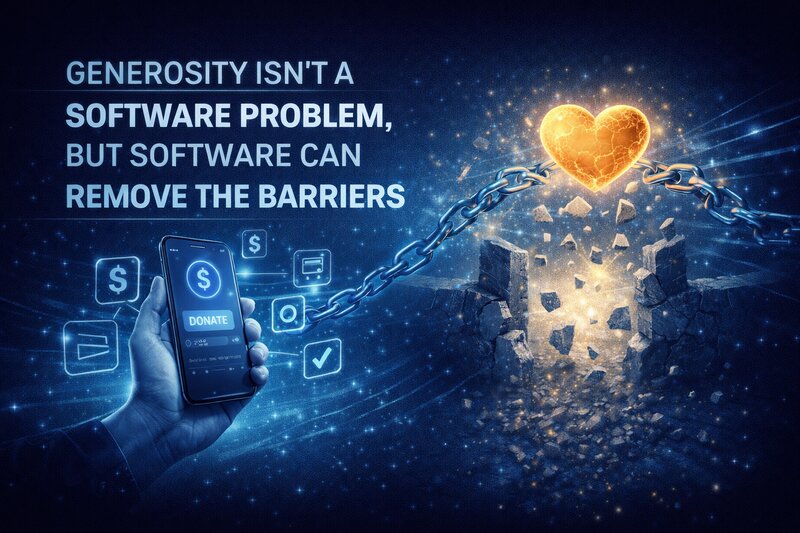
A generous impulse can disappear when the giving path is confusing. Someone may want to give toward a building fund, open the church website, click the giving link, hit a complicated account setup, and give up before the gift is complete. The problem is not the heart. The problem is the path between decision and action.
Generosity is formed long before anyone touches a keyboard
The instinct to equate giving technology with generosity itself is easy to fall into. We see a new giving platform with slick features and high conversion rates, and some part of us begins to believe that if we just get the right tool, our people will give more. As if the software creates the generosity.
It doesn’t. It never has.
Generosity is a spiritual discipline. It is shaped by years of teaching, modeled by community, rooted in a person’s understanding of who God is and what God has entrusted to them. No app builds that. No platform cultivates that. No text-to-give shortcode replaces the slow, patient work of forming people who hold their resources with open hands.
A church where generosity is thriving didn’t get there because they picked the right vendor. They got there because someone taught stewardship clearly, modeled it honestly, and gave people a theological framework for understanding that what they have belongs to God. The giving platform was involved in the transaction. It was not involved in the transformation.
This distinction matters because it protects us from two errors. The first is expecting technology to solve a discipleship problem. The second is dismissing technology because it can’t solve a discipleship problem. Both errors cost churches something real.
The place where good intentions go to die
If generosity is purely a heart issue, then why does the method matter at all? If someone is truly generous, won’t they find a way to give regardless of the process?
In theory, yes. In practice, not always.
We know this from our own lives. We intend to do things all the time that we never follow through on. Not because our intentions were false, but because something got in the way. The friction was just enough to break the momentum between decision and action.
A family that wants to give $150 this month may not do it if giving requires them to remember their login credentials every Sunday morning while corralling children into the car. A retired couple who has given faithfully for 40 years may quietly reduce their giving when the church moves to a digital-only platform that feels confusing and impersonal to them. A young professional who gives impulsively after a meaningful sermon may never complete the gift if the process takes seven steps instead of two.
None of these people stopped being generous. They encountered friction at the worst possible moment: the moment they were ready to act.
This is the gap that technology is actually designed to fill. Not creating generosity. Clearing the path so generosity can move from intention to completion without unnecessary obstacles.
What friction actually looks like in a church
Friction in a giving process doesn’t announce itself. It accumulates quietly, and the people affected by it rarely say anything. They just give less, or give less often, or stop giving digitally and wait until they’re in the building with cash. Some of them drift away from giving altogether, not out of a change of heart, but out of accumulated frustration they don’t know how to articulate.
The most common forms of friction in church giving are surprisingly mundane.
Requiring account creation before a first gift. Most people giving to a church for the first time, or giving online for the first time, will abandon the process if they have to create a username and password before they can enter a dollar amount. This is well-documented in e-commerce research, and churches are not exempt from it. The person isn’t lazy. They’re being asked to make a secondary commitment (creating an account) before they can complete their primary intention (making a gift). That secondary commitment creates just enough hesitation to kill follow-through.
Too many steps between intention and completion. Every additional screen, every extra form field, every “please confirm” dialogue adds a small amount of resistance. Any single one is manageable. Stacked together, they wear down the resolve that brought someone to the giving page in the first place. The churches that see the highest digital giving completion rates tend to have the simplest giving flows: amount, fund (if needed), payment method, done.
Lack of mobile optimization. A significant portion of church giving happens on phones, often during or immediately after a service. If the giving page isn’t designed for a phone screen, if buttons are too small, if the page loads slowly, if the form doesn’t auto-advance between fields, you’re asking people to fight their device while trying to be generous. Most of them won’t.
Confusing fund structures. When a giving page presents someone with 12 different fund options and no guidance about which one to choose, the cognitive load of making that decision can stall the entire gift. People who came to give $50 to the general fund don’t want to wonder whether “General Operating” is the same as “Tithes and Offerings” or whether they should be giving to “Ministry Fund” instead. Simplify the options. Label them clearly. Make the default choice obvious.
These are not dramatic failures. They’re paper cuts. And paper cuts add up. A church of 100 people losing even a few completed gifts each month to process friction is leaving thousands of dollars on the table each year. Dollars that were already intended for the church. Dollars that generous people wanted to give.
The stewardship case for reducing friction
Reducing friction is not just a practical concern. It’s a theological one.
If we believe that giving is an act of worship, then we have a stewardship responsibility to make that act of worship accessible. Not easy in the sense of requiring nothing from the giver, but accessible in the sense of not placing unnecessary obstacles between a willing heart and a completed gift.
Consider the parallel with other areas of church life. We don’t make the sanctuary hard to find because worship should require effort. We don’t make the sermon hard to hear because truth should be pursued. We put up signs. We invest in a sound system. We print bulletins. We create pathways that help people engage with what God is doing.
Giving is no different. When someone in our church is ready to give, our job is to make sure the process doesn’t get in their way. That’s not a marketing strategy. That’s stewardship of the generosity God has already stirred in someone’s heart.
A church of 80 people that reduces its giving page from eight steps to three isn’t manipulating anyone into giving more. It’s removing barriers that were preventing willing givers from completing what they already intended to do. The generosity was already present. The church just stopped accidentally suppressing it.
What software can do (and what it cannot)
Software can make giving fast. It can make giving available at any time from any device. It can allow someone to set up a recurring gift in 90 seconds so their generosity continues even when life gets busy. It can process a gift during a sermon, after a conversation, at two in the morning when someone feels moved to respond to something they’ve been praying about. It can send a receipt automatically, track giving for year-end statements, and save a church administrator hours of manual work every month.
Software cannot make someone generous. It cannot build a culture of stewardship. It cannot replace the moment when a pastor looks at the congregation and teaches, with conviction and clarity, that everything we have is on loan from God. It cannot substitute for the elder who gives quietly and consistently and whose example shapes how younger members think about their own resources.
Confusing these two categories leads to one of two problems. Churches that expect too much from their giving platform will be disappointed when a new tool doesn’t move the needle. Churches that expect too little will tolerate unnecessary friction because they believe generosity should overcome any obstacle. Both positions are incomplete.
The better framing: technology is infrastructure. Like a road. A road doesn’t make someone want to travel to a destination. But a road full of potholes will stop plenty of people from getting there, even when they want to go.
Our job is to keep the road clear.
Practical implications for your church
If you’re evaluating your church’s giving process, the question isn’t “which platform will make our people give more?” The question is “where are we accidentally making it harder for generous people to follow through?”
Start by giving to your own church. Pull out your phone right now and walk through the entire process as if you’ve never done it before. Time it. Count the steps. Note every moment of confusion or hesitation. If you get frustrated, your congregation has been getting frustrated too. They’ve just been too polite to tell you.
Then ask a few people who aren’t technologically confident to try it. Watch them. Don’t help. Just observe. The places where they pause, squint at the screen, or ask a question are the places where your giving process is leaking.
You don’t necessarily need a new platform. You may just need to simplify what you already have. Remove unnecessary fund options. Turn on guest giving so first-timers don’t need an account. Make sure your giving page loads quickly on a phone. Check that the confirmation screen actually confirms the gift instead of redirecting to a homepage.
These adjustments are small. They cost nothing. And they honor the generosity that already exists in your church by getting out of its way.
Generosity deserves a clear path
The deepest work of generosity happens in the hearts of your people, shaped by Scripture, modeled by leaders, and formed over years of faithful teaching. No technology replaces that work. No platform shortcuts it.
But generous people deserve a giving process that respects their intention. They deserve a path from decision to action that doesn’t punish them with extra clicks, confusing options, or broken pages. They deserve a church that has thought carefully about the experience of giving, not because giving is a transaction, but because it’s an act of worship.
When we reduce friction in the giving process, we aren’t engineering generosity. We are removing the barriers that stand between a generous heart and a completed gift. That’s not a software problem. That’s a stewardship responsibility.
The generous impulse is God’s work. Clearing the path is ours.

Recent Posts
-
 “Broadcast” was a farming word first, and it changes how you read Matthew 13
 -
 What broadcasting actually looks like in an ordinary week
 -
 The one ChMS report that tells you if people are actually connecting
 -
 Breeze vs ChurchTrac: Which One Fits a Smaller Church Better?
 -
 How to evaluate church management software for your size church