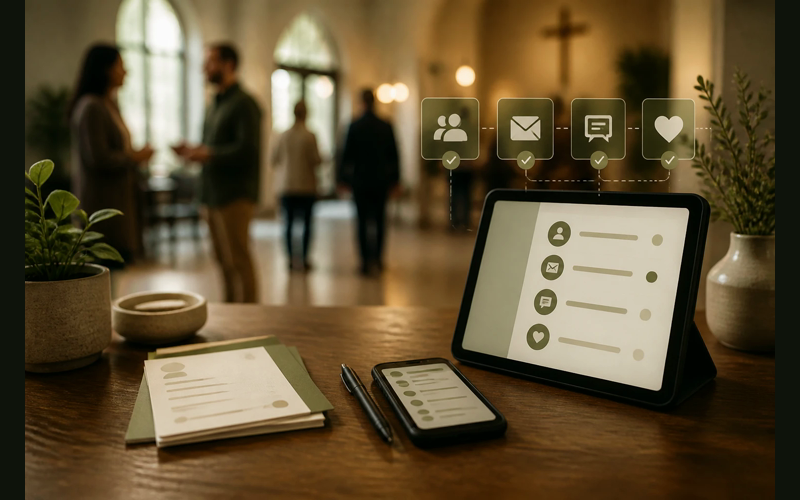
This scenario plays out in churches every Sunday. A woman signs the guest book in the lobby, sits near the back, stays through the whole service. She mentions to a greeter on the way out that she’s recently moved to the area and is looking for a church home.
Nobody calls her that week, or emails, or sends a card. By the following Sunday, she’s visited another church down the road, and that church did follow up. She never comes back to the first one.
That first church wasn’t careless. The pastor later said he’d fully intended to reach out. The greeter who spoke with her forgot to pass along her name. The guest book sat on the lobby table until Wednesday, when someone finally flipped it open and realized they’d missed three new names.
Good intentions were there. A working system wasn’t.
Visitor follow-up as stewardship
Most of us think about stewardship in terms of money, time, or the building we worship in. We rarely frame the people who walk through our doors as something we’ve been entrusted with, at least temporarily.
But that’s exactly what a first-time visitor represents. Someone made a decision to show up. That decision had weight behind it. Maybe they drove past two other churches to get to yours. Maybe this was the first time they’d been to any church in years.
When that person leaves and we lose their name, their contact information, or simply the fact that they were there at all, we haven’t just missed a follow-up opportunity. We’ve failed to steward a moment that mattered to someone.
The churches that are getting this right aren’t necessarily the ones with the biggest budgets or the most staff. They’re the ones that decided to pay attention, and then built a simple system to make sure attention doesn’t depend on one person’s memory.
Paper connection cards still work
There’s a version of this conversation where someone tells you that paper is dead and you need to go fully digital immediately. That isn’t this conversation.
Plenty of churches still use paper connection cards, and some of them do it well. The ones that work tend to share a few traits. The cards are short. They ask for a name, an email or phone number, and maybe one checkbox: “I’m visiting for the first time.” They’re placed on every seat before the service, not buried in a pew rack where no one looks. And someone, usually one specific person, collects them within an hour of the service ending and enters the information somewhere that same day.
The churches where paper fails are the ones where the cards go into a stack on somebody’s desk and sit there until Tuesday or Wednesday. By then, the window for a meaningful follow-up has narrowed considerably. Churches that consistently follow up within 48 hours report noticeably better return rates than those that wait longer. After that two-day window, the likelihood drops sharply.
The paper itself works fine. What kills it is the delay between collecting the card and acting on it.
How automation changes the follow-up
A lot of churches are moving from manual processes to automated ones, specifically around what happens after someone’s information gets collected.
A growing number of churches use a QR code printed on the connection card or displayed on screen during the service. Visitors scan it with their phone, fill out a short digital form, and that information flows directly into the church’s database. It skips the handwriting, the Monday morning data entry, and the cards that disappear between seat cushions.
But the real value is what happens next. Several church management platforms now allow you to set up automated workflows triggered by that form submission. The visitor gets a welcome email within minutes. A follow-up task gets assigned to the pastor or a volunteer for a personal phone call within 24 hours. A second email goes out three days later with information about small groups or an upcoming event.
That kind of automated sequence is where tools like Breeze come in. Breeze calls theirs Follow-Up Progressions, which chain tasks together so that completing one step automatically triggers the next. A pastor at a 120-person church can set this up once and know that every visitor gets the same thoughtful sequence of touches without anyone having to remember each step manually. For churches on a tighter budget, ChurchTrac handles visitor tracking alongside giving, attendance, and communication starting under $9 a month, which puts it within reach of church plants and smaller congregations.
If your church already uses Planning Center for worship planning or volunteer scheduling, adding their people management module keeps visitor tracking in the same ecosystem. And for churches already processing donations through Tithe.ly, their bundled management tools mean you can handle visitor follow-up without adding another login or another monthly bill.
None of these platforms require a full-time administrator to run. That matters. Most of the churches considering these tools don’t have an office manager, a database coordinator, or an administrative pastor. They have one person, often the lead pastor, doing everything.
A typical follow-up sequence
Someone makes personal contact in the first 24 hours. A phone call, a text, maybe a short handwritten note dropped in the mail. The key word is personal, not an automated blast, but a real person acknowledging that a specific visitor showed up and was noticed.
A few days later, a second touchpoint follows. This one is usually informational: what to expect next Sunday, how to connect with a small group, when the next community event is happening. Some churches include a short video from the pastor.
Then, around the two or three week mark, a third contact invites the visitor to take a next step. An open door, not a pressure move. “We have a lunch for newcomers on the first Sunday of each month. You’re welcome to join us.”
Some churches run this sequence manually with a checklist and a calendar reminder. Others automate the emails and texts through their ChMS and keep only the personal phone call as a manual step. Both approaches work. What separates churches that retain visitors from those that don’t is rarely the sophistication of the system. It’s whether a system exists at all.
The ownership problem
Most pastors who hear about visitor tracking assume the obstacle is technology. The real obstacle is that no one has been specifically assigned the responsibility.
In a church of 60 people, the pastor often assumes the greeters are tracking visitors. The greeters assume the pastor will follow up. The office volunteer assumes someone already entered the information. And the visitor assumes no one noticed they were there.
The churches doing this well, regardless of size, have made one clear decision: they named a person. One person owns the visitor follow-up process. They might delegate pieces or automate parts of it. But one person looks at the list every Sunday afternoon and makes sure nothing falls through.
That person doesn’t need to be the pastor. In some churches, a lay volunteer with a gift for hospitality and a smartphone is better suited for the role than a pastor who’s already carrying the weight of preaching, counseling, and administration.
The only question that matters
We see this pattern regularly in smaller churches. Someone volunteers to own the follow-up process, sets up a simple digital connection card through a tool like ChurchTrac, and starts texting every visitor that same Sunday afternoon. A reminder goes out to check in again the following week.
Nothing about their Sunday morning changes. They didn’t add staff or buy expensive software. They just decided that the people who walk through their doors deserve to be noticed, and they built a system simple enough to make that happen every single week.
Whether you use a paper card or a QR code, whether you automate or do it by hand, the question that matters is whether someone specific is responsible for making sure every visitor gets followed up with.
Every visitor who comes to your church made a decision to be there. That decision cost them something, even if it was just the effort of showing up somewhere unfamiliar. The least we can do is make sure we noticed.
Recent Posts
-
 “Broadcast” was a farming word first, and it changes how you read Matthew 13
 -
 What broadcasting actually looks like in an ordinary week
 -
 The one ChMS report that tells you if people are actually connecting
 -
 Breeze vs ChurchTrac: Which One Fits a Smaller Church Better?
 -
 How to evaluate church management software for your size church