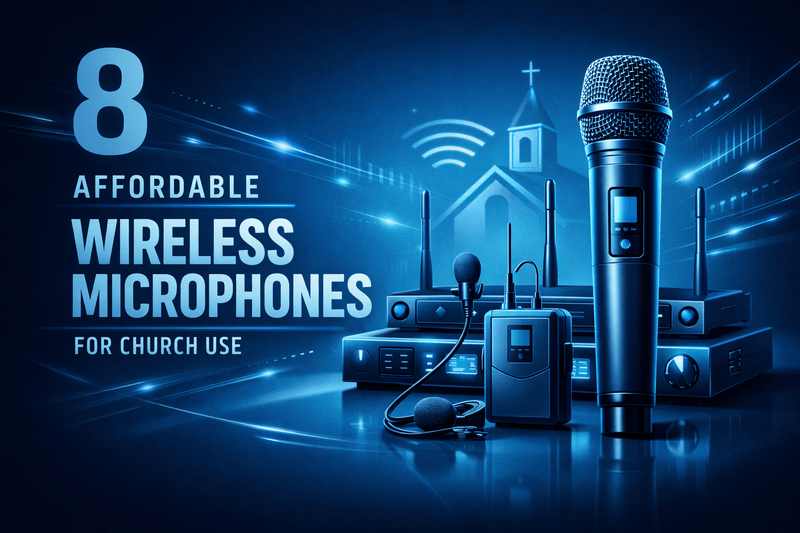
A wireless microphone failure can derail a service quickly. Static, dropouts, weak batteries, and mismatched equipment pull attention away from preaching and worship at the exact moment the room needs clarity.
Wireless microphone technology has improved at price points that would have seemed impossible ten years ago. You do not need to spend thousands of dollars to get reliable, clear wireless audio in your worship space. You do need to spend wisely.
This roundup covers eight wireless microphone systems across three price tiers. Each one is genuinely suited for church use, and each one comes with honest trade-offs worth understanding before you buy. Whether you’re running sound for 40 people in a rented school gym or 400 in a dedicated sanctuary, there’s a system here that fits.
A few things worth knowing first
Wireless microphone systems operate on specific radio frequencies, and two terms matter most when you’re shopping: UHF (Ultra High Frequency) and digital 2.4 GHz. UHF systems have been the standard in professional audio for decades. They offer excellent range and reliability, but some older UHF frequencies are now restricted by the FCC. Any system you buy should operate in a legal frequency band. The systems listed here all do.
Digital 2.4 GHz systems are newer to the market. They tend to be more affordable, more compact, and they avoid the frequency regulation issues entirely. The trade-off is that they share bandwidth with Wi-Fi networks, Bluetooth devices, and other 2.4 GHz equipment. In a church building with heavy Wi-Fi usage, that can occasionally cause interference. It’s manageable, but it’s real.
Battery life, operating range, and microphone type (handheld, lapel, headset) all matter depending on how your church actually uses a wireless mic. A pastor who paces while preaching needs something different from a worship leader who stays near a music stand. A children’s ministry volunteer doing announcements has different needs than a guest speaker who arrives five minutes before service.
Think about your actual use cases before you think about specs.
Budget tier: under $200
1. Fifine K031B wireless handheld system
Price: Around $60
Type: Handheld
Frequency: UHF
Battery Life: Approximately 6 hours (2 AA batteries)
Range: Up to 80 feet
This is the system for the church that genuinely has almost nothing to spend on audio and needs something functional right now. The Fifine K031B is a single-channel UHF handheld mic with a compact receiver that plugs directly into a mixer or powered speaker.
It works. The audio quality is acceptable for speech in a small room. The build quality is plastic and lightweight. It will not impress your sound tech if they come from a professional audio background. But for a church plant meeting in a living room, a small group that needs amplification for an older member, or a youth ministry running its own program in a side room, it does the job at a price point that removes every financial excuse.
The trade-offs are real. You get one channel, so you can only run one mic. The range is limited. The sound quality is noticeably below professional-grade systems. This is a starter mic, not a forever mic. Buy it knowing that, and it will serve you well for exactly what it is.
Available at: Amazon, B&H
2. Innopow WM-200 dual wireless handheld system
Price: Around $130
Type: Dual handheld
Frequency: UHF
Battery Life: Approximately 6 hours per mic (AA batteries)
Range: Up to 200 feet
If you need two wireless handhelds on the tightest possible budget, the Innopow WM-200 is surprisingly capable. The dual-channel receiver means two people can use wireless mics simultaneously, which opens up announcements, interviews, responsive readings, or having a backup mic ready to hand off.
Audio clarity is decent for the price. You’ll hear a slight hiss at higher gain levels, which is typical at this tier. The metal mic bodies feel more substantial than some competitors. Two hundred feet of advertised range is generous for the price, though real-world performance in a building with walls and interference will be somewhat less.
This system is a solid pick for a church under 100 people that needs two wireless handhelds and can’t spend more than $100 on the pair.
Available at: Amazon
3. Phenyx pro PTU-5000A dual wireless system
Price: Around $110
Type: Dual handheld (lapel and headset compatible with separate transmitter purchase)
Frequency: UHF
Battery Life: Approximately 8 hours per mic (2 AA batteries)
Range: Up to 260 feet
Channels: 200 selectable frequencies
The Phenyx Pro PTU-5000A is where you start crossing into semi-professional territory without leaving the budget tier. Two hundred selectable UHF frequencies mean you can find a clean channel even in environments with other wireless equipment operating nearby. The dual handheld mics deliver clear, full-bodied audio that works well for both speech and singing.
The metal construction on both the receiver and transmitters feels durable. Eight hours of battery life on AAs is enough for a full Sunday of services with room to spare. The receiver has individual volume controls for each channel, which gives your sound operator meaningful control over the mix.
What makes this system particularly worth noting is expandability. You can purchase additional bodypack transmitters from Phenyx Pro and use lapel or headset microphones on the same receiver. That means you can start with two handhelds and later add a lapel mic for your pastor without replacing the whole system. For a church that wants to invest gradually, that flexibility matters.
Available at: Amazon, B&H
Mid tier: $200 to $500
4. Audio-technica ATW-1102 system 10a
Price: Around $349
Type: Handheld
Frequency: 2.4 GHz digital
Battery Life: Approximately 7 hours (2 AA batteries)
Range: Up to 100 feet
Audio-Technica is a name that carries weight in professional audio circles, and the System 10a is their entry point for digital wireless. The 2.4 GHz digital operation means no frequency coordination, no FCC compliance worries, and automatic channel selection. You turn it on and it finds a clean channel on its own.
The audio quality is a noticeable step up from the budget tier. Clear, natural sound reproduction with very low noise floor. The handheld transmitter uses Audio-Technica’s own dynamic capsule, which handles both speech and vocals with confidence.
The 100-foot range is the main limitation. In a larger sanctuary, that could be tight. But for most churches under 300 seats, it’s more than adequate. The digital signal processing also means no compander artifacts, that slightly compressed or “swimmy” sound that cheaper analog wireless systems sometimes produce.
If you’re buying one wireless handheld and want it to sound genuinely good without spending professional-install money, this is a strong choice.
Available at: Sweetwater, Amazon, B&H
5. Shure BLX14/CVL wireless lapel system
Price: Around $350
Type: Lapel (lavalier)
Frequency: UHF (H10 band: 542-572 MHz)
Battery Life: Approximately 14 hours (2 AA batteries)
Range: Up to 300 feet
Shure is the industry standard in professional audio, and the BLX14/CVL is the system that puts a Shure lapel mic on your pastor at a price that most churches can work toward. The CVL lavalier microphone is a condenser element that captures clear, detailed speech with a cardioid pickup pattern, meaning it focuses on the speaker’s voice and reduces ambient noise from the room.
Fourteen hours of battery life is exceptional. You could run this system through two full Sundays on a single set of AAs and still have juice left. The 300-foot range means your pastor can walk anywhere in the building and still be heard clearly.
The BLX receiver uses Shure’s QuickScan technology to find the best available frequency in your area automatically. In a multi-wireless environment where you’re running several systems at once, that feature saves real headaches.
This is the first system on this list that most professional sound engineers would consider “proper” wireless. The CVL lavalier is small, discreet, and clips easily to a collar, tie, or lapel. For pastors who preach with their hands, who move around the platform, and who don’t want to think about holding a microphone, this is the system to target.
Available at: Sweetwater, Amazon, B&H
6. Shure BLX14/SM31FH wireless headset system
Price: Around $429
Type: Headset (fitness/performance style)
Frequency: UHF (H10 band: 542-572 MHz)
Battery Life: Approximately 14 hours (2 AA batteries)
Range: Up to 300 feet
The BLX14/SM31FH pairs Shure’s BLX wireless platform with their SM31FH headset microphone, which was designed for fitness instructors and performers who move aggressively. That makes it well-suited for the pastor who doesn’t just pace the stage but actively gestures, turns, and walks into the congregation while preaching.
The SM31FH sits securely on the head with a flexible, moisture-resistant boom arm that positions the microphone element near the corner of the mouth. It stays put during movement. The cardioid condenser capsule delivers consistent, clear audio regardless of head position, which solves the common lapel mic problem where turning your head means your voice fades in and out.
Everything else mirrors the BLX14/CVL: 14 hours of battery life, 300-foot range, UHF reliability, QuickScan frequency selection. The difference is entirely in the microphone element and wearing style.
Some pastors resist headset microphones because of how they look. That’s a personal call. But for audio consistency during active preaching, a headset outperforms a lapel mic every time. If your preaching style involves significant movement, this is worth the conversation.
Available at: Sweetwater, Amazon, B&H
Upper tier: $500 to $800
7. Sennheiser EW-D 835-S wireless handheld system
Price: Around $749
Type: Handheld
Frequency: UHF digital (R1-6 band: 520-576 MHz)
Battery Life: Approximately 12 hours (Sennheiser BA 70 rechargeable battery or 2 AA batteries)
Range: Up to 100 meters (328 feet)
Sennheiser’s Evolution Wireless Digital line represents what professional-grade wireless sounds like at the lowest price Sennheiser has ever offered it. The EW-D 835-S uses a digital UHF signal path, which means you get the range and building-penetration advantages of UHF combined with the clean, artifact-free audio of digital processing.
The 835-S handheld transmitter houses Sennheiser’s e835 dynamic capsule, a microphone element trusted on professional stages worldwide. The sound is full, warm, and present. Speech intelligibility is outstanding. The built-in mute switch on the transmitter gives the speaker direct control, which is useful for passing the mic during announcements or prayer time.
The receiver connects and configures through Sennheiser’s Smart Assist app, which walks you through frequency coordination on your phone. That’s genuinely helpful in buildings where you’re running multiple wireless systems and need to ensure they don’t interfere with each other.
At this price, you’re paying for reliability, audio quality, and build quality that will serve your church for years. The rechargeable battery option also means your ongoing battery costs drop to nearly zero, which matters when you’re counting every dollar.
Available at: Sweetwater, B&H
8. Shure BLX288/PG58 dual wireless handheld system
Price: Around $593
Type: Dual handheld
Frequency: UHF (H10 band: 542-572 MHz)
Battery Life: Approximately 14 hours per mic (2 AA batteries each)
Range: Up to 300 feet
If your church needs two professional-quality wireless handhelds and you want to buy once, this is the system. The BLX288 receiver handles two channels simultaneously, and each PG58 handheld transmitter delivers Shure’s signature vocal clarity.
The PG58 capsule is designed specifically for vocal use. It handles the full dynamic range of both speaking and singing, making it equally useful for a pastor preaching and a worship leader singing. That versatility is valuable in a church setting where one mic might be used for the sermon and the other for worship leading, all in the same service.
With 14 hours of battery life per mic and 300 feet of range, you have more than enough capacity for any typical Sunday. The dual-receiver design also simplifies your sound setup. One rack unit, one power cable, two channels. Clean and straightforward.
The BLX288/PG58 is the system you buy when you want to stop thinking about wireless microphones for a long time. It won’t be the last wireless system your church ever owns, but it will reliably serve for years without causing problems on Sunday morning.
Available at: Sweetwater, Amazon, B&H
How to choose
Price tiers exist for real reasons. A $50 microphone is not doing the same thing as a $500 microphone, and pretending otherwise would be dishonest. But the right question isn’t “what’s the best mic?” The right question is “what’s the best mic for where we are right now?”
If your church is just getting started and every dollar is accounted for, a Fifine or Innopow system gets you wireless capability today. There is no shame in that. The goal is clear audio for the people sitting in your room, and these systems deliver it at a level that would have required ten times the investment fifteen years ago.
If you have a modest budget and want to invest in something with staying power, the Audio-Technica and Shure BLX systems represent the sweet spot where audio quality, reliability, and price genuinely intersect. The Shure BLX platform in particular has become something of a standard for small to mid-size churches for good reason.
If you can stretch to the upper tier, the Sennheiser EW-D and Shure BLX288 systems deliver professional performance that your sound team will appreciate and your congregation will hear the difference in, even if they can’t articulate why.
Whatever you choose, a few practical habits matter more than which microphone you buy. Use fresh batteries every Sunday morning. Do a sound check before the room fills up. Store your microphones properly between services. Train your volunteers on how to hand off a mic without creating a feedback loop. These habits cost nothing and extend the life and performance of any system.
Good audio isn’t about having the most expensive equipment. It’s about being thoughtful with whatever equipment you have. That principle applies to microphones the same way it applies to everything else in ministry.
Recent Posts
-
 “Broadcast” was a farming word first, and it changes how you read Matthew 13
 -
 What broadcasting actually looks like in an ordinary week
 -
 The one ChMS report that tells you if people are actually connecting
 -
 Breeze vs ChurchTrac: Which One Fits a Smaller Church Better?
 -
 How to evaluate church management software for your size church